
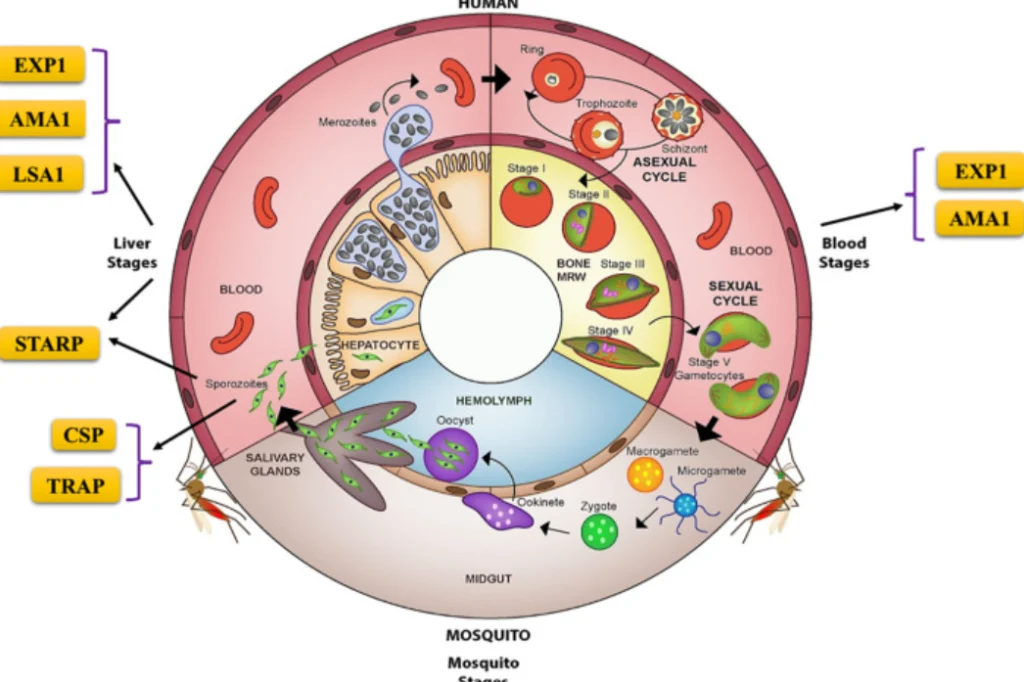
The malaria life cycle is among the most complex disease cycles in nature because it involves two living hosts: a human and a female Anopheles mosquito. Malaria is not caused by dirty water, poor air quality, or the weather itself. It is caused by tiny single-celled parasites from the genus Plasmodium, which enter the human body through the bite of an infected mosquito.
The most important thing to understand is this: malaria is not just a mosquito problem. It is a parasite survival system. The mosquito carries the parasite; the human body provides it space to multiply; and the parasite changes form several times to stay alive.
According to the World Health Organization, five Plasmodium species can cause malaria in humans, with Plasmodium falciparum and Plasmodium vivax posing the greatest threat. P. falciparum is the deadliest species and is especially common in Africa, while P. Vivax is more common in many areas outside sub-Saharan Africa.
Recent global data also shows why understanding the malaria life cycle still matters. The WHO reported an estimated 282 million malaria cases and 610,000 deaths worldwide in 2024, showing that malaria remains a major health challenge.
Q: What is the malaria life cycle?
A: The malaria life cycle is the full journey of the Plasmodium parasite as it moves from mosquito to human, grows in the liver, multiplies in red blood cells, and returns to another mosquito.
Q: What are the main stages of malaria?
A: The main stages are sporozoite, liver stage, merozoite, blood stage, gametocyte, zygote, ookinete, oocyst, and new sporozoites inside the mosquito.
Q: Why is the malaria life cycle dangerous?
A: It is dangerous because the parasite hides inside liver cells and red blood cells, multiplies quickly, causes fever and anemia, and can become severe without fast treatment.
Quick Life Cycle Table
| 1. Mosquito bite | Human skin and blood | An infected female Anopheles mosquito injects sporozoites into its host. |
| 2. Liver stage | Human liver | Sporozoites enter liver cells and multiply silently. |
| 3. Blood stage | Red blood cells | Parasites invade red blood cells and multiply within them. |
| 4. Symptoms begin | Human body | Red blood cells burst, causing fever, chills, weakness, and anemia. |
| 5. Gametocyte stage | Human blood | Some parasites can exist in both male and female sexual forms. |
| 6. Mosquito feeding | Mosquito gut | A mosquito bites an infected person and ingests gametocytes. |
| 7. Sexual reproduction | Mosquito gut | Gametocytes form a zygote, then an ookinete. |
| 8. Oocyst stage | Mosquito gut wall | Parasites multiply again inside an oocyst. |
| 9. New sporozoites | Mosquito salivary glands | Sporozoites move to the salivary glands, ready to infect another human. |
The CDC describes malaria as a two-host cycle involving humans and Anopheles mosquitoes, beginning when the mosquito injects sporozoites into the human host.
The History of Their Scientific Naming
The scientific naming of malaria parasites has a long history. For centuries, people thought malaria came from “bad air” around swamps. The word malaria itself comes from Italian words meaning “bad air.” That idea was wrong, but the name stayed.
Key points in the naming history:
- In 1880, French doctor Charles Louis Alphonse Laveran observed parasites in the blood of patients with malaria. This was a major turning point because it showed that a living organism, not air, was the cause of malaria.
- Laveran first called the organism Oscillaria malariae.
- In 1885, Italian scientists Ettore Marchiafava and Angelo Celli placed the parasite in the genus Plasmodium.
- The name Plasmodium falciparum later became linked with the deadliest human malaria parasite.
- The species name falciparum is derived from the Latin word falx, meaning “sickle-shaped,” because some parasite forms appear curved or crescent-shaped.
This naming history matters because it shows how science moved from myth to microscope. Once researchers understood the parasite, they could study its life cycle, transmission, diagnosis, and prevention.
Their Evolution And Their Origin
The origin of malaria is closely linked to the evolution of Plasmodium parasites, mosquitoes, primates, and humans. Malaria did not suddenly appear as a modern disease. Its roots go far back into the natural history of parasites and their hosts.
Modern research shows that some major human malaria parasites likely came from parasites that infected African apes. Studies on Plasmodium falciparum suggest that this deadly parasite originated in gorillas and entered human populations through cross-species transmission.
This does not mean gorillas “gave” malaria to humans in a simple way. Evolution is slower and more complex. Mosquitoes, forests, animal hosts, and human movement all played roles. Over time, some parasite lines became better adapted to humans.
Plasmodium vivax also has an important evolutionary story. For many years, some scientists believed it may have originated in Asia. Newer evidence, however, supports an African origin for P. vivax and related parasites.
The evolution of malaria also shaped human biology. In areas where malaria has been common for generations, certain blood traits have become more common because they offer partial protection. One well-known example is the sickle cell trait, which can reduce the risk of severe P. falciparum malaria in some people.
So, the malaria life cycle is not just a medical topic. It is also an evolutionary story. The parasite evolved ways to survive in humans and mosquitoes, while humans evolved defenses against it.
Important Things That You Need To Know
To understand the malaria life cycle, you also need to understand the disease itself. Malaria is a serious parasitic infection, but it is preventable and treatable when diagnosed early.
The main keyword here is malaria, but related search terms also matter because people often look for symptoms, causes, prevention, and treatment at the same time.
Important related terms include malaria symptoms, malaria treatment, malaria prevention, malaria parasite, and malaria mosquito.
Malaria symptoms often appear after the parasite reaches the blood stage. Common signs include fever, chills, sweating, headache, body pain, nausea, and tiredness. In severe cases, malaria can cause anemia, breathing problems, confusion, seizures, organ failure, or death.
Malaria treatment depends on the parasite species, severity, drug resistance patterns, age, pregnancy status, and location. People should not guess or self-treat severe malaria. Fast testing and proper medical care are important.
Malaria prevention focuses on stopping mosquito bites and reducing mosquito breeding. Bed nets, indoor spraying, repellents, protective clothing, drainage management, and preventive medicine for travelers can reduce risk.
The malaria parasite is the true cause of the disease, while the malaria mosquito serves as the vector. Only infected female Anopheles mosquitoes transmit malaria during blood feeding.
This is why malaria control needs two actions at once: protect people from mosquito bites and stop the parasite from completing its life cycle.
Their main food and its collection process
The Plasmodium parasite does not eat like an animal. It has no mouth, teeth, or stomach. Instead, it absorbs and breaks down nutrients from the host cells it infects.
Its “food collection process” depends on its stage in the malaria life cycle.
- In the human liver:
- After entering the body, sporozoites travel to the liver. Inside liver cells, the parasite uses nutrients from the host cell to grow and multiply. This stage is often silent because the person may not yet feel sick.
- In red blood cells:
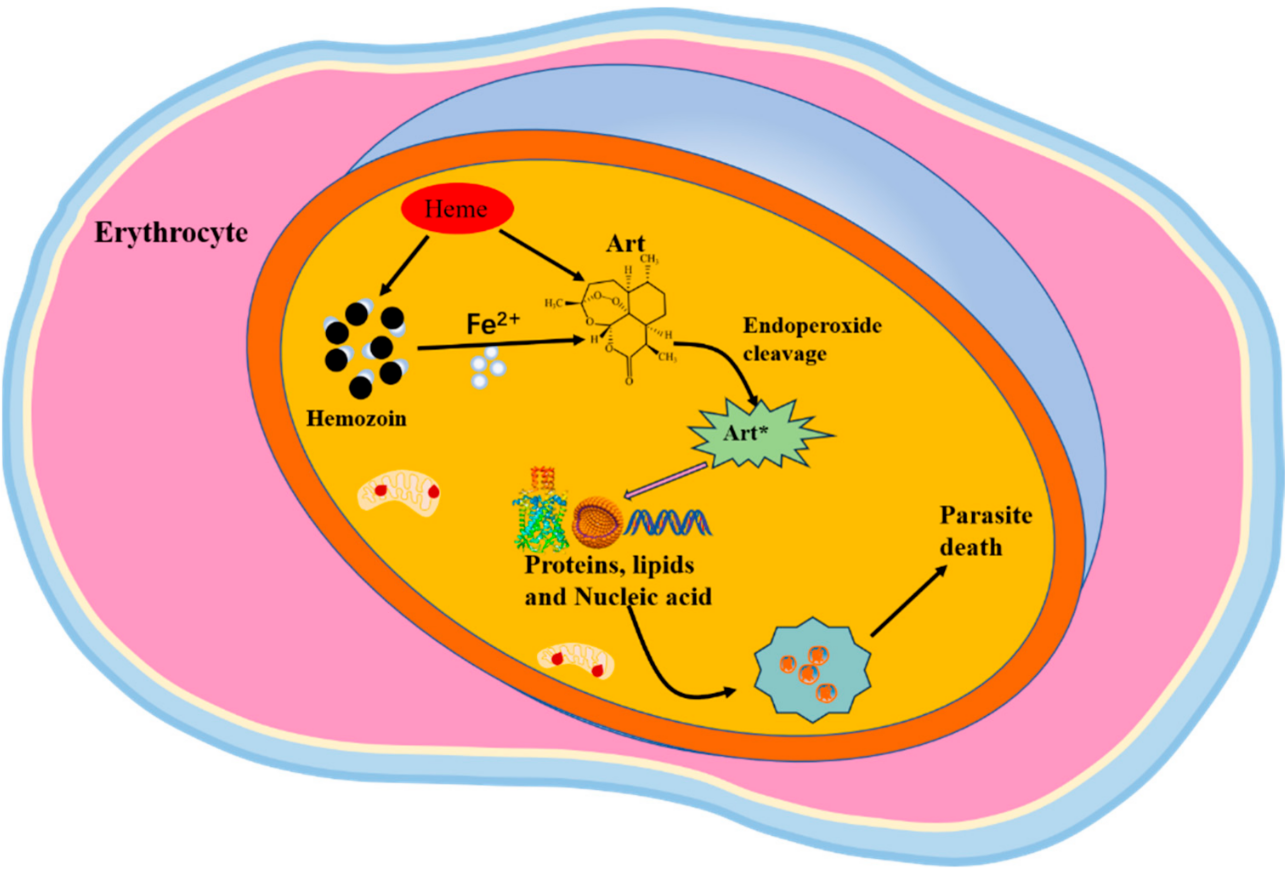
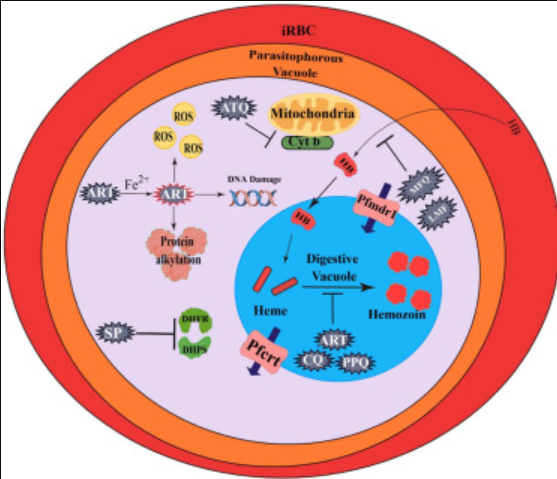
- The parasite’s most important feeding stage happens inside red blood cells. Here, it digests hemoglobin, the protein that carries oxygen in the blood.
- Hemozoin formation:
- When the parasite digests hemoglobin, it releases toxic heme. To survive, it converts this harmful material into a safer crystal-like waste called hemozoin, also known as malaria pigment.
- Glucose use:
- The parasite also depends heavily on glucose for energy. Since it multiplies quickly, it needs a steady supply of energy from the host environment.
- Inside the mosquito:
- In the mosquito, the parasite does not feed on human blood the same way it does in human blood. It uses resources available within the mosquito’s gut and tissues as it develops into new infectious sporozoites.
The mosquito also has its own feeding pattern. Female Anopheles mosquitoes drink blood mainly to support egg production. They may also feed on plant sugar or nectar for energy. When they bite an infected person, they can collect the parasite’s sexual forms, called gametocytes, along with the blood.
Their life cycle and ability to survive in nature
Survival Through Two Hosts
The malaria parasite survives because it uses two hosts: humans and female Anopheles mosquitoes. Each host gives the parasite something different.
The human body gives it liver cells and red blood cells where it can multiply. The mosquito gives it a place for sexual reproduction and a way to reach another human.
Hiding in the Liver
One of the parasite’s best survival strategies is to enter the liver soon after infection. At this stage, the immune system may not notice it easily. In some species, especially Plasmodium vivax and Plasmodium ovale, dormant forms called hypnozoites can stay in the liver and cause relapse later.
This makes malaria harder to eliminate.
Multiplying in Blood
After the liver stage, the parasite enters red blood cells. This blood stage causes most malaria symptoms. The parasites multiply inside the cells, then burst out and infect more cells.
This repeated bursting is one reason fever often comes in cycles.
Surviving in Mosquitoes
When another mosquito bites an infected person, it may take in gametocytes. These forms do not cause symptoms directly, but they are important for transmission.
Inside the mosquito gut, the parasite goes through sexual development and produces new sporozoites. These sporozoites move to the mosquito’s salivary glands, where they await the next bite.
This ability to change shape, location, and function is what makes the malaria parasite so successful in nature.
Their Reproductive Process and raising their children
The malaria parasite does not raise children like birds, mammals, or insects. It has no parental care. But it does produce new parasite stages through both asexual and sexual reproduction.
Key points in the reproductive process:
- Asexual reproduction in the liver:
- After sporozoites enter liver cells, they multiply into many new forms called merozoites. This is like a silent expansion phase.
- Asexual reproduction in red blood cells:
- Merozoites enter red blood cells and multiply again. When the cell bursts, more merozoites are released. This creates waves of infection in the blood.
- Formation of gametocytes:
- Some parasites do not continue the asexual blood cycle. Instead, they develop into male and female gametocytes.
- Sexual reproduction in the mosquito:
- When a mosquito feeds on infected blood, it ingests gametocytes. Inside the mosquito’s gut, male and female forms fuse to form a zygote.
- Ookinete stage:
- The zygote becomes a moving form called an ookinete, which passes through the mosquito gut wall.
- Oocyst stage:
- The ookinete forms an oocyst, where many new parasites develop.
- New sporozoites:
- The oocyst releases sporozoites, which move to the mosquito’s salivary glands.
There is no care, feeding, protection, or teaching of young parasites. The malaria parasite survives by producing many offspring-like stages and placing them in the right host at the right time.
This is reproduction through quantity, timing, and host switching.
The importance of them in this Ecosystem
A Natural Parasite With Strong Biological Influence
The malaria parasite is part of nature, but that does not mean it is good for humans. Its role is mainly parasitic. It survives by feeding on hosts and using mosquitoes for transmission.
In ecosystems, parasites can influence animal populations, host immunity, mosquito biology, and evolutionary pressure. Plasmodium species infect many animals, including birds, reptiles, rodents, primates, and humans.
Connection With Mosquitoes and Hosts
The malaria parasite connects three parts of nature: the mosquito, the host, and the environment. Wetlands, rainfall, temperature, standing water, housing conditions, and human movement can affect mosquito populations and malaria risk.
This makes malaria both a biological and environmental issue.
Evolutionary Pressure on Humans
Malaria has shaped human evolution in powerful ways. In places where malaria has been common for a long time, certain inherited blood traits have become more common because they offer some protection against severe disease.
This shows how a tiny parasite can influence human genetics over many generations.
Why It Should Not Be Protected as a Disease Agent
Even though parasites have ecological roles, malaria parasites should not be protected or spread. They cause suffering, death, poverty, school absence, and economic loss.
The smarter goal is to protect the Ecosystem while reducing malaria transmission. That means controlling mosquitoes safely, improving healthcare, and avoiding careless environmental damage.
A healthy ecosystem and malaria prevention can work together.
What to do to protect them in nature and save the system for the future
For malaria, the right goal is not to protect the parasite. The goal is to protect human life, protect useful biodiversity, and manage the environment wisely. Malaria control should reduce disease without destroying nature.
- Use insecticide-treated bed nets.
- Bed nets reduce night-time mosquito bites and help stop the malaria life cycle.
- Remove standing water near homes.
- Mosquitoes breed in stagnant water. Cleaning drains, containers, and puddles can reduce breeding sites.
- Improve house protection
- Window screens, closed doors, covered water tanks, and better roofing can reduce mosquito entry.
- Support early diagnosis
- Fever in malaria-risk areas should be tested quickly. Early treatment reduces severe disease and lowers transmission.
- Use medicines correctly
- Incomplete or wrong treatment can support drug resistance. Malaria medicine should be taken as advised by health professionals.
- Protect wetlands carefully
- Not all water bodies should be destroyed. Some wetlands support birds, fish, insects, and plants. Control should focus on risky breeding areas near people.
- Avoid overuse of chemicals.
- Heavy misuse of insecticides can harm beneficial insects and increase mosquito resistance.
- Support community awareness
- People should know how malaria spreads, when to seek care, and how to prevent mosquito bites.
- Use targeted mosquito control.
- Larval control, indoor spraying, and environmental management should be done based on local risk.
- Protect children and pregnant women first.
- These groups are at higher risk of severe malaria and need special prevention and care.
The future of malaria control depends on balance: fewer infections, stronger health systems, cleaner surroundings, and smarter environmental care.
Frequently Asked Questions (FAQs)
Q1: What is the malaria life cycle?
A: The malaria life cycle is the process where Plasmodium parasites move between humans and female Anopheles mosquitoes, multiply in the liver and blood, then return to mosquitoes for sexual reproduction.
Q2: What parasite causes malaria?
A: Malaria is caused by Plasmodium parasites. The main human species are P. falciparum, P. vivax, P. malariae, P. ovale, and P. knowlesi.
Q3: Which stage of malaria infects humans?
A: The sporozoite stage infects humans. It enters the body when an infected female Anopheles mosquito bites a person.
Q4: Which stage of malaria causes symptoms?
A: The blood stage causes most symptoms. This is when parasites invade red blood cells and burst them, leading to fever, chills, weakness, and anemia.
Q5: Why does malaria fever come and go?
A: Malaria fever often comes in cycles because infected red blood cells burst in waves, releasing parasites and triggering immune reactions.
Q6: Can malaria stay hidden in the body?
A: Yes. Some species, especially Plasmodium vivax and Plasmodium ovale, can form dormant liver stages called hypnozoites, which may cause relapse later.
Q7: How does a mosquito get malaria?
A: A mosquito gets malaria when it bites an infected person and takes in gametocytes, the sexual forms of the parasite.
Q8: How can the malaria life cycle be stopped?
A: The cycle can be stopped by preventing mosquito bites, using bed nets, controlling mosquito breeding, diagnosing infections early, and treating malaria correctly.
Conclusion
The malaria life cycle is a powerful example of how a tiny parasite can use nature with great precision. It moves from mosquito to human, hides in the liver, multiplies in red blood cells, and returns to another mosquito to continue its journey.
Understanding this cycle is not just useful for students. It helps families, communities, health workers, and policymakers fight malaria more effectively. Every stage offers a potential control point. We can stop mosquito bites, reduce breeding sites, test for fever early, treat infections properly, and protect the most vulnerable people.
Malaria is ancient, but it is not unbeatable. The parasite survives through timing, adaptation, and host switching. Humans can respond with knowledge, prevention, science, and community action.
A better future means breaking the malaria life cycle while protecting the natural systems around us. That is the real balance: healthier people, safer homes, and smarter care for the environment.
Also Read: life cycle of honey bee





Leave a Reply