
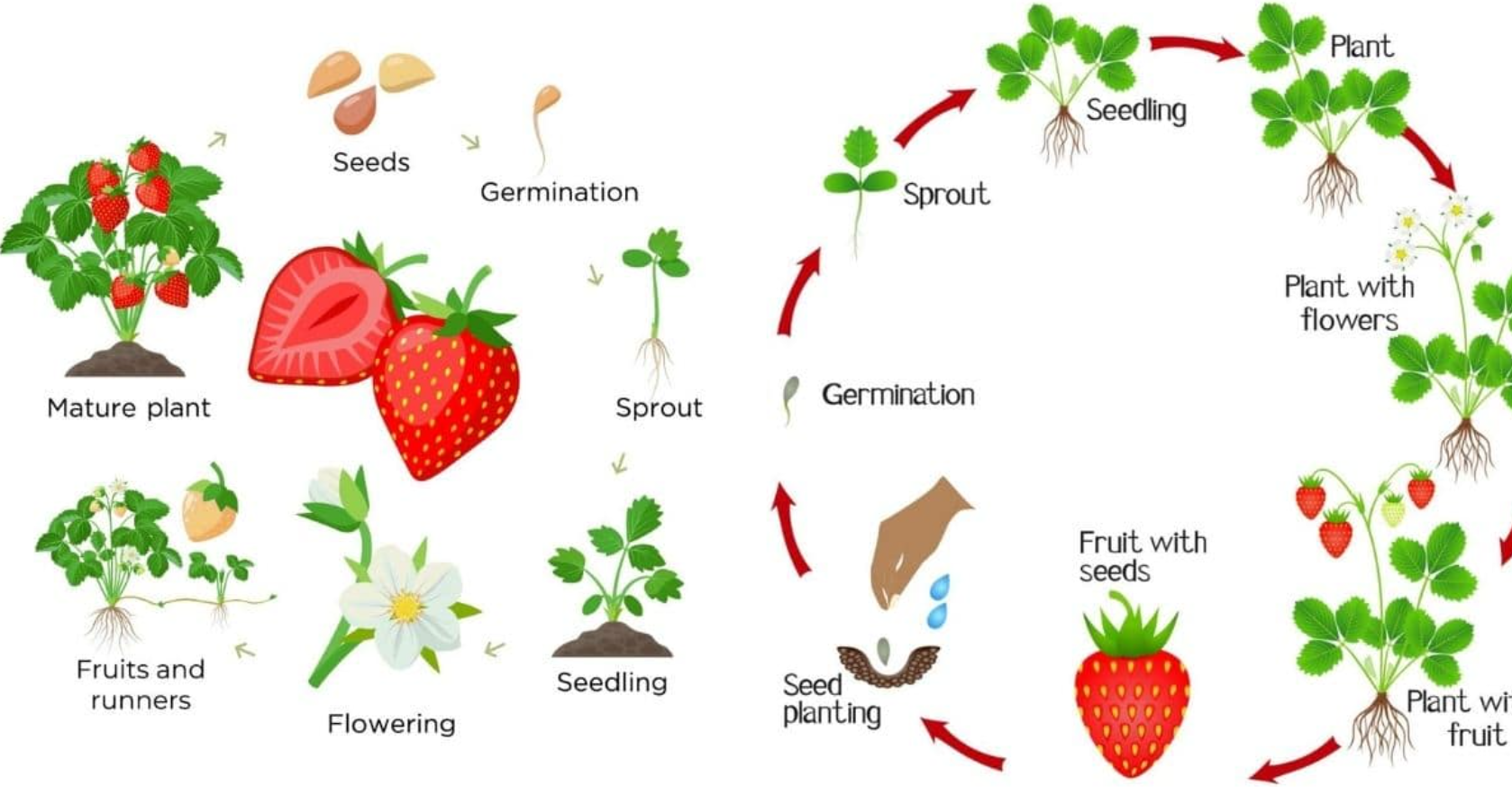
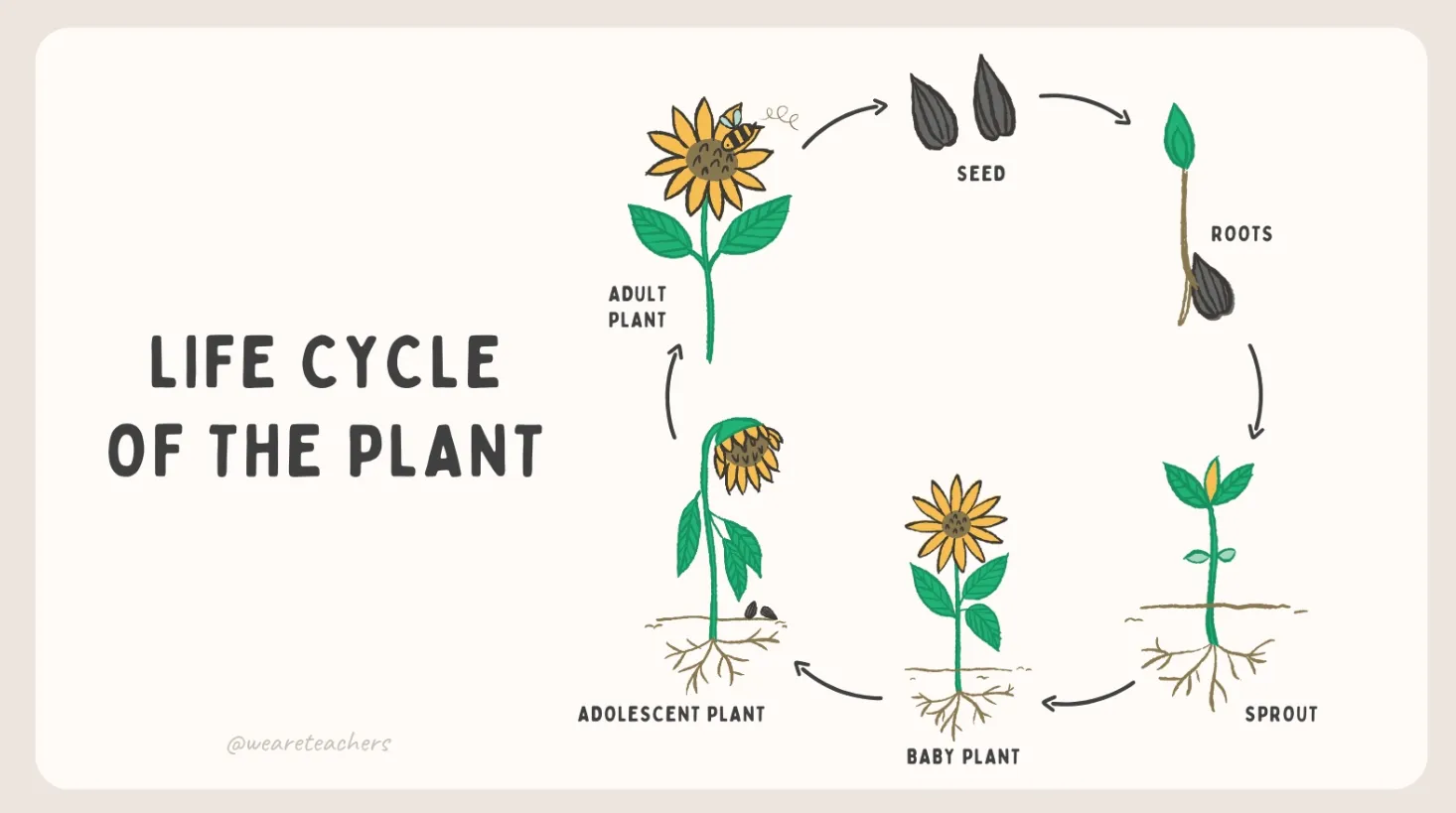
The strawberry life cycle is the complete journey of a strawberry plant from a tiny seed or young plant to a mature plant that produces flowers, fruits, runners, and new daughter plants. A strawberry looks simple from the outside, but its growth process is very interesting. It starts with root development, leaf growth, flowering, pollination, fruit formation, seed production, and finally the spread of new plants through runners.
The common garden strawberry is scientifically known as Fragaria × ananassa. It belongs to the Rosaceae, or rose family, and is widely grown worldwide for its sweet red fruit. The garden strawberry is a hybrid plant derived from parent species native to North America and Chile, and it became popular in Europe in the 18th century.
A strawberry plant is also special because it can reproduce in two main ways: by seeds and by runners. Runners are long stems that grow from the mother plant and create new daughter plants. This makes strawberries very successful in gardens, farms, and natural spaces.
Q: How long does the strawberry life cycle take?
A: From planting to harvest, many strawberry plants can produce fruit in about 60 to 90 days, depending on variety, weather, soil, and care.
Q: Is a strawberry a true berry?
A: No. Botanically, a strawberry is not a true berry. It is an aggregate accessory fruit, and the tiny seed-like dots on the outside are called achenes.
Q: How do strawberry plants make new plants?
A: They make new plants through runners, also called stolons, and through seeds after flowers are pollinated.
Quick Life Cycle Table
| Stage | What Happens | Simple Meaning |
| Seed or young plant | The plant begins life from a seed, crown, or runner plant | Starting point |
| Germination | A seed grows roots and tiny leaves | Baby plant begins |
| Vegetative growth | Leaves, roots, and crown become stronger | Plant builds energy |
| Runner formation | Long stems grow and form daughter plants | Plant spreads |
| Flowering | White flowers appear | Reproduction starts |
| Pollination | Pollen moves inside the flower, often helped by insects | Fruit can form |
| Fruit development | The red strawberry grows from the flower base | Edible fruit stage |
| Seed stage | Achenes on the fruit carry seeds | Next generation |
| Dormancy or renewal | Plants slow their growth in cold or stressful periods | Survival stage |
The History of Their Scientific Naming
The scientific naming of the strawberry is closely connected to its smell, family, and hybrid origin.
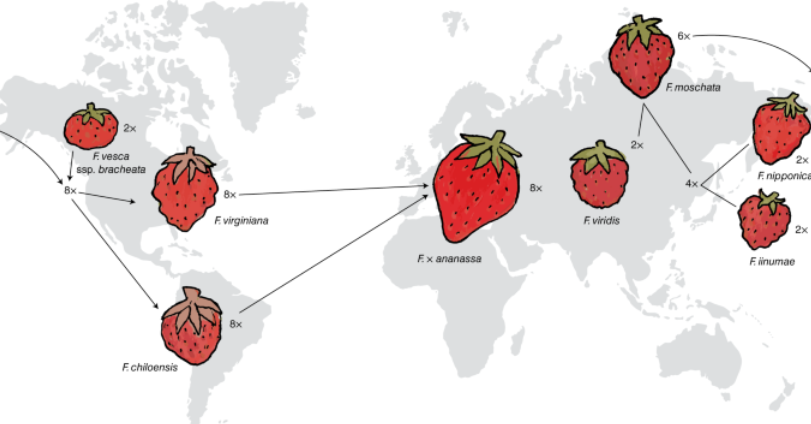
The genus name Fragaria is linked with the idea of fragrance. This makes sense because ripe strawberries are known for their sweet smell. The garden strawberry is called Fragaria × ananassa. The “×” sign indicates that it is a hybrid, meaning it is the offspring of two different parent species.
The modern garden strawberry developed in Europe, especially in France, during the 18th century. It came from the crossing of Fragaria virginiana, a species native to eastern North America, and Fragaria chiloensis, a species native to Chile. This hybrid created the larger, sweeter strawberry that later became popular in gardens and commercial farms.
The common name “strawberry” has several possible explanations. One idea is that the name comes from “strewn berry,” because the plant spreads across the ground by runners, and its fruits appear scattered. Another common belief connects the name with straw mulch used around plants, but the older “strewn berry” idea is often considered more likely.
Their Evolution And Their Origin
The origin of the strawberry plant is a story of natural diversity, human selection, and plant hybridization. Wild strawberries existed long before modern farming. These wild plants were smaller than the strawberries we usually eat today, but they had a strong aroma and were valued by humans for food and medicine.
The modern garden strawberry, Fragaria × ananassa, arose from the crossing of two wild species. One parent, Fragaria virginiana, came from eastern North America. It was known for good flavor. The other parent, Fragaria chiloensis, originated from the Pacific coast of South America and was known for its larger fruit. When these two species crossed in Europe, the result was a bigger and more useful strawberry plant.
Over time, people selected plants with larger fruit, sweeter taste, stronger growth, and higher yields. This process is called selective breeding. Farmers and plant breeders continued to improve strawberry varieties so they could grow in different climates, seasons, soils, and farming systems.
The evolution of strawberries is also linked to their survival features. Their low-growing shape protects them from strong winds. Their crown stores energy. Their roots collect water and nutrients. Their runners allow them to spread quickly without depending only on seeds.
This combination of sexual reproduction through flowers and asexual reproduction through runners made strawberries very successful. Today, strawberries are grown in home gardens, farms, greenhouses, and controlled environments across many parts of the world.
Their main food and its collection process
The strawberry plant does not eat food like animals. It makes its own food through a natural process called photosynthesis. This process happens mainly in the leaves.
Here is how the food collection process works:
- Leaves collect sunlight
- The green leaves of the strawberry plant contain chlorophyll. Chlorophyll captures sunlight and helps the plant make energy.
- Carbon dioxide enters through leaf pores.
- Tiny openings on the leaves, called stomata, take in carbon dioxide from the air. This gas is needed to make plant food.
- Water comes from the roots.
- The roots absorb water from the soil. Water moves upward through the plant and supports growth, flowering, and fruit development.
- Minerals come from the soil.
- Roots also absorb nutrients such as nitrogen, phosphorus, and potassium. These nutrients help leaves, roots, flowers, and fruits grow properly.
- Sugar is made inside the plant.
- Using sunlight, water, and carbon dioxide, the plant produces sugar. This sugar gives energy to the whole plant.
- Extra energy supports fruit growth.
- When the plant has enough energy, it can produce flowers and sweet fruits. Good sunlight, healthy soil, and proper watering help strawberries become larger and tastier.
The crown is also important because it connects the roots, leaves, flowers, and runners. It works like the central growth point of the strawberry plant.
Important Things That You Need To Know
The word strawberry is used in many ways, not only for the fruit. When people search for the strawberry life cycle, they may also see related terms such as strawberry elephant, strawberry moon, and strawberry cake. The word strawberry connects these terms, but they do not all mean the same thing.
First, a strawberry refers to the real fruit and plant. This article mainly explains the biological life cycle of the strawberry plant, including roots, leaves, flowers, fruits, seeds, and runners.
Second, a strawberry elephant is not a real plant or scientific term. It is mostly used online as a creative or meme-style phrase. Some current online uses describe it as a fantasy character or fruit-animal idea, not a real part of strawberry biology.
Third, the strawberry moon is a cultural name for a full moon, often linked to the strawberry-harvesting season in some traditions. It does not mean the moon becomes a strawberry, and it is not part of the plant life cycle.
Fourth, strawberry cake is a food made using strawberries or strawberry flavor. It shows how important strawberries are in human food culture.
So, when studying the strawberry life cycle, focus on the real plant. The other terms are useful for search meaning, culture, recipes, and online trends, but the biological story belongs to the living strawberry plant.
Their life cycle and ability to survive in nature
Seed and germination stage
The strawberry life cycle can begin from a seed. Each tiny achene on the outside of a strawberry contains a seed inside it. When the seed gets moisture, warmth, air, and suitable soil, it can germinate.
At this stage, the first root grows downward, and the first tiny shoot grows upward. The young plant starts to build its own leaves.
Vegetative growth stage
After germination, the plant grows more leaves and roots and develops a stronger crown. This stage is important because the plant must collect enough energy before it can make flowers and fruits.
Healthy leaves mean better photosynthesis. Strong roots mean better water and nutrient collection.
Flowering and fruiting stage
When conditions are suitable, the plant produces flowers. Strawberry flowers are usually white with yellow centers. These flowers contain male and female parts so that they can reproduce.
Pollination helps the flower turn into fruit. Complete pollination usually helps strawberries grow larger and more evenly shaped. Pollinators such as bees are very important for good strawberry production.
Runner and survival stage
Strawberry plants survive well because they produce runners. A runner grows away from the mother plant and forms a daughter plant when it touches the soil.
This helps strawberries spread fast in nature. Even if one plant becomes weak, daughter plants can continue the life cycle.
Dormancy stage
In cold weather or stressful conditions, strawberry plants may slow down. This is called dormancy. During dormancy, the plant saves energy and protects its crown until better growing conditions return.
Their Reproductive Process and raising their children
The strawberry plant reproduces in two main ways: through flowers and seeds, and through runners and daughter plants. Since strawberries are plants, they do not raise children like animals. However, the mother plant supports new plants until they can grow on their own.
- Flower production
- Mature strawberry plants produce flowers. These flowers are the starting point of sexual reproduction.
- Pollination
- Pollen must reach the female part of the flower. Strawberry flowers can be self-fertile, but insect pollination improves fruit quality. Better pollination usually produces better-shaped strawberries.
- Fruit formation
- After pollination, the base of the flower becomes the red, fleshy strawberry. The tiny dots on the outside are achenes, each containing a seed.
- Seed dispersal
- In nature, animals and birds may eat strawberries. The seeds can later spread to new places.
- Runner production
- The plant also sends out long stems called runners or stolons. These runners produce daughter plants.
- Daughter plant support
- At first, the daughter plant stays connected to the mother plant. This connection helps it receive support while it forms roots.
- Independent growth
- Once the daughter plant develops roots in the soil, it can grow independently. This is the plant version of “raising children.”
This dual reproduction system makes strawberries strong and successful. Seeds provide genetic diversity, while runners quickly create copies of a healthy parent plant.
The importance of them in this Ecosystem
Food source for humans and animals
Strawberries are an important food source. Humans eat strawberries fresh, in desserts, in drinks, in jams, and in products like strawberry cake. In nature, birds, small mammals, and insects may also feed on strawberry fruits.
The fruit helps spread seeds when animals eat it and move to another place.
Support for pollinators
Strawberry flowers provide nectar and pollen for insects. Bees and other pollinators visit the flowers and help the plant produce better fruit. This relationship benefits both sides: insects get food, and strawberry plants get pollinated.
Pollination is especially important because incomplete pollination can lead to smaller or misshapen fruit. Research and extension sources commonly highlight pollinators as critical for strawberry production.
Soil cover and ground protection
Strawberry plants grow close to the ground. Their leaves help cover the soil, reduce direct sunlight on the soil surface, and lower erosion risk in small garden systems.
Their roots also help hold soil in place.
Plant diversity
Wild and cultivated strawberries add diversity to natural and human-managed ecosystems. They connect soil organisms, insects, birds, animals, and people through food and reproduction.
Economic and cultural value
Strawberries are also important in farming and the food industry. They are used in fresh markets, desserts, drinks, jams, and flavoring. Their popularity makes them valuable for both small gardeners and commercial growers.
What to do to protect them in nature and save the system for the future
Protecting strawberry plants means protecting soil, water, pollinators, and natural habitats. A healthy strawberry system depends on more than just the fruit.
- Protect pollinators
- Avoid using harmful pesticides, especially during flowering. Bees and other insects help strawberries produce better fruit.
- Grow pollinator-friendly flowers nearby.
- Plant flowers that bloom at different times. This gives pollinators food before and after strawberry flowering.
- Use healthy soil practices.
- Add compost, organic matter, and mulch. Healthy soil supports strong roots and better fruit growth.
- Avoid overwatering
- Too much water can damage roots and increase the risk of disease. Keep soil moist but not waterlogged.
- Protect the crown
- The crown is the heart of the strawberry plant. Do not bury it too deeply, nor leave it fully exposed.
- Use mulch
- Straw, dry leaves, or other safe mulch can protect fruit from soil contact and help control weeds.
- Choose disease-resistant varieties
- Strong varieties reduce the need for chemical control and help plants survive better.
- Save runners carefully
- Let healthy runners form daughter plants. This keeps the next generation strong.
- Rotate planting areas
- Do not grow strawberries in the same tired soil again and again. Rotation helps reduce disease buildup.
- Protect natural spaces
- Wild strawberries and related plants support biodiversity. Avoid destroying natural plant habitats unnecessarily.
By protecting strawberries, we also protect pollinators, soil life, food chains, and future fruit production.
Frequently Asked Questions (FAQs)
Q1: What is the strawberry life cycle?
A: The strawberry life cycle is the growth journey of a strawberry plant from seed or young plant to roots, leaves, flowers, fruits, seeds, runners, and new daughter plants.
Q2: How long does it take for strawberries to grow?
A: Many strawberry plants can produce fruit in about 60 to 90 days after planting, but the exact time depends on variety, season, temperature, sunlight, and care.
Q3: Do strawberry plants come back every year?
A: Yes. Strawberries are perennial plants, meaning they can live for more than one year if the crown and roots remain healthy.
Q4: Are strawberries true berries?
A: No. Botanically, strawberries are not true berries. They are aggregate accessory fruits, and the seed-like dots outside are called achenes.
Q5: What are strawberry runners?
A: Runners are long stems that grow from the mother strawberry plant. They form daughter plants that can root in the soil and become new strawberry plants.
Q6: Do strawberries need bees?
A: Strawberry flowers can self-pollinate, but bees and other pollinators improve fruit size, shape, and quality. Good pollination usually means better strawberries.
Q7: What is the best condition for strawberry growth?
A: Strawberries grow best with good sunlight, well-drained soil, proper moisture, healthy roots, and protection from weeds, pests, and disease.
Q8: What is the difference between strawberry seeds and runners?
A: Seeds create new plants with genetic variation, while runners create daughter plants that are clones of the mother plant. Both are part of strawberry reproduction.
Conclusion
The strawberry life cycle is a beautiful example of how a small plant can grow, reproduce, survive, and support the Ecosystem. From a tiny seed or young runner plant, the strawberry develops roots, leaves, flowers, fruits, seeds, and daughter plants. Its life cycle is simple to observe but rich in biological meaning.
The strawberry plant survives through smart natural strategies. It makes its own food through photosynthesis, attracts pollinators with flowers, produces sweet fruits, and spreads through runners. These features make it useful in gardens, farms, and natural habitats.
Strawberries are also important for people, animals, insects, soil systems, and food culture. Whether someone is learning about plant science, growing strawberries at home, or searching for strawberry life cycle information, understanding each stage helps explain why this plant is so successful.
In short, the strawberry is more than a sweet fruit. It is a living plant with a complete, active, and valuable life cycle.
Also Read: life cycle of honey bee





Leave a Reply