
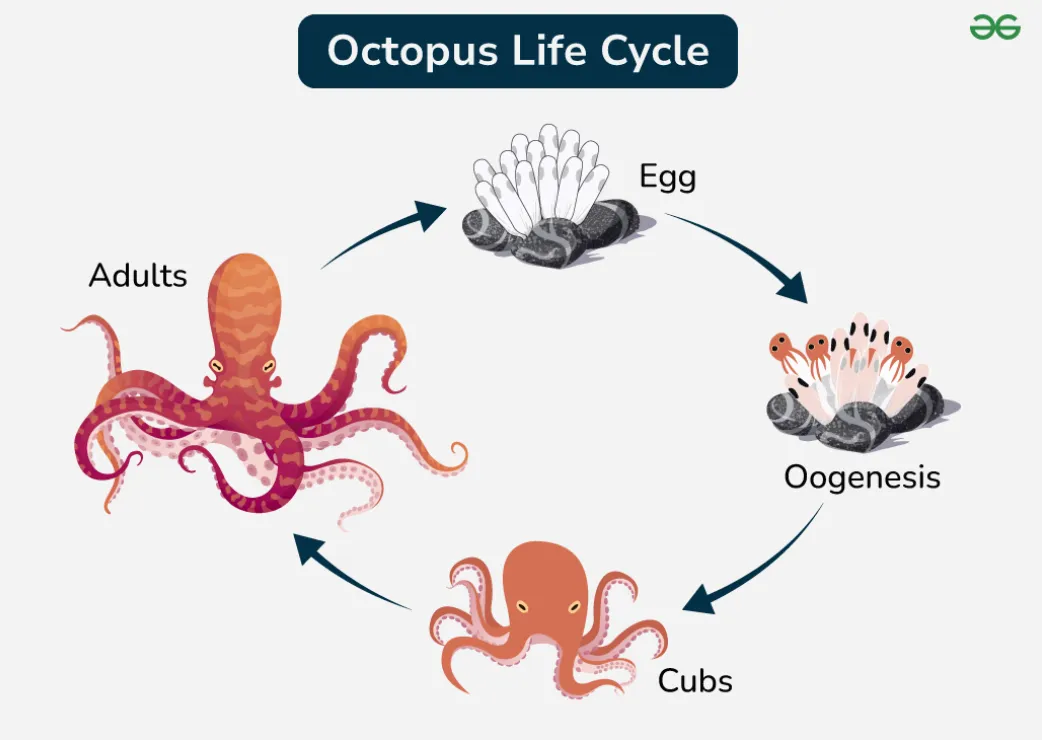
The octopus life cycle is one of the most fascinating stories in the ocean. An octopus is a soft-bodied marine mollusk from the class Cephalopoda and the order Octopoda. It has eight arms, a sharp beak, excellent eyesight, advanced problem-solving ability, and a body that can squeeze into surprisingly small spaces because it has no bones. Around 300 octopus species are known, and they live in every ocean, from shallow reefs and tide pools to deep-sea habitats.
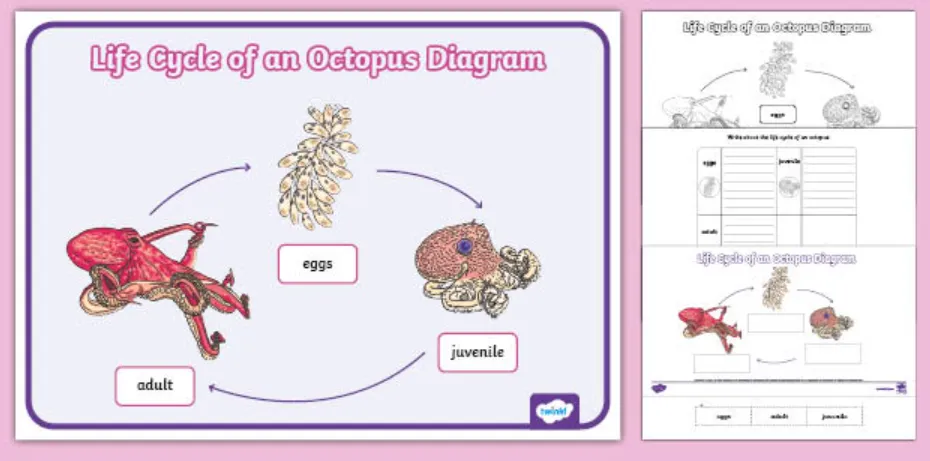
Most octopuses have a short but intense life. Their development usually moves through four main stages: egg, paralarva, juvenile, and adult. However, the timing differs among species. A small tropical octopus may live only about one year, while the giant Pacific octopus can live around three to five years.
A key feature of the octopus life cycle is that reproduction is usually the final stage of life. The male often dies after mating, and the female usually dies after guarding and caring for her eggs. This single-reproduction strategy is called semelparity.
Q: What are the main stages of the octopus life cycle?
A: The main stages are egg, paralarva, juvenile, and adult.
Q: How long does an octopus live?
A: Many octopus species live about one to two years, but larger species such as the giant Pacific octopus may live three to five years.
Q: Do octopus mothers care for their babies?
A: They care deeply for the eggs, but not for the hatched young. The female guards the eggs, cleans them, and oxygenates them, then usually dies after they hatch.
Important Things That You Need To Know
The octopus life cycle is not only about growth; it is also about survival, intelligence, camouflage, reproduction, and ocean balance. Different species show different lifestyles. For example, the giant Pacific octopus is known for its large size, strong arms, and relatively longer lifespan. In contrast, the dumbo octopus belongs to deep-sea finned octopuses that move with ear-like fins and live in cold, dark habitats.
The blue-ringed octopus is famous for being small yet highly venomous. Its venom contains tetrodotoxin, a powerful neurotoxin that can cause paralysis and respiratory failure in humans. It should never be touched in the wild.
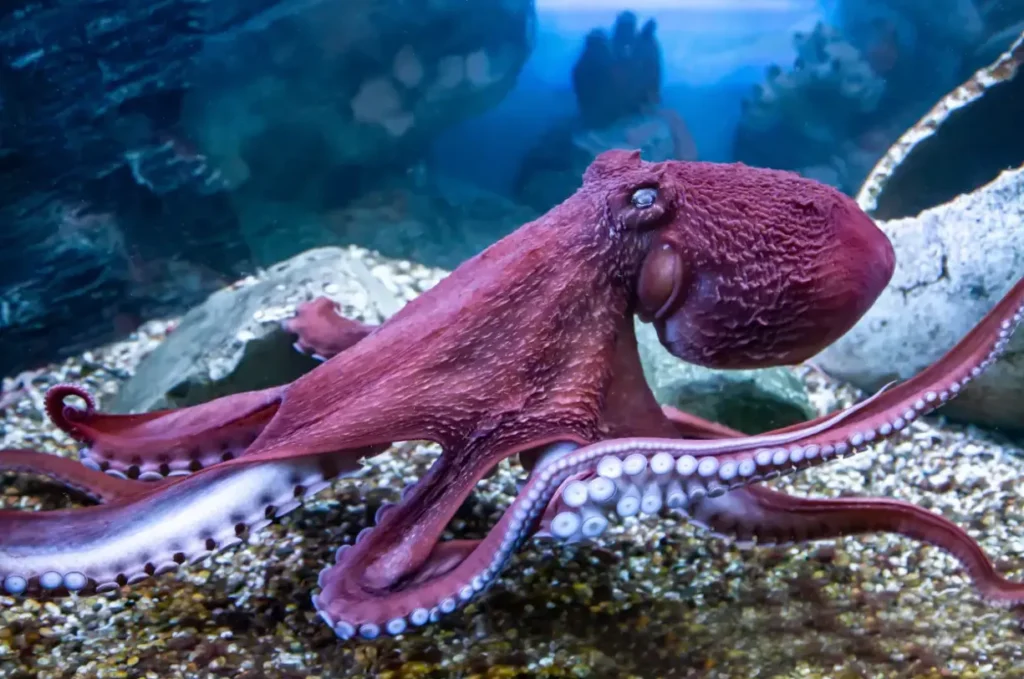
Searches like octopus drawing often come from students, artists, and educators who want to understand the animal’s unique body shape. A correct drawing should show eight arms, a round mantle, eyes, a siphon, webbing near the arms, and suckers.
The phrase “sushi nigiri octopus near me” connects octopus to the seafood culture. Still, it also raises an important point: people should choose responsibly sourced seafood and avoid supporting undersized or overharvested octopus.
The documentary My Octopus Teacher also increased public interest in octopus intelligence, curiosity, and emotional connection with nature. It helped many people see the octopus not just as seafood, but as a complex marine animal worthy of respect.
Quick Life Cycle Table
| Stage | Where It Happens | What Happens | Key Survival Challenge |
| Egg | Attached to a den, cave, rock space, or protected surface | The female lies and guards eggs, keeps them clean, and fans oxygen-rich water over them | Predators, low oxygen, fungus, and temperature stress |
| Paralarva | Open water/plankton zone in many species | Tiny hatchlings drift and feed on small planktonic prey | Very high predation and starvation risk |
| Juvenile | Seafloor, reef, tide pool, rocky area, or soft sediment | Young octopus settles, hides, hunts small prey, and grows quickly | Finding shelter and avoiding predators |
| Adult | Species-specific marine habitat | Hunts actively, defends territory or den, mates, and completes reproduction. | Reproduction, predation, fishing pressure, habitat change |
Many shallow-water octopuses hatch into planktonic paralarvae, but some large-egg or deep-sea species may develop more directly into benthic young. Scientists describe these as different reproductive strategies among octopuses.
The History of Their Scientific Naming, Evolution, and Origin
Scientific Naming of Octopus
The scientific order name Octopoda was established by English biologist William Elford Leach in 1818. The word relates to the animal’s eight-footed or eight-armed body form. Modern octopuses belong to the phylum Mollusca, class Cephalopoda, and order Octopoda, placing them close to squids, cuttlefish, and nautiluses.
Evolutionary Origin
Octopuses evolved from ancient marine mollusks. Unlike shelled mollusks, modern octopuses lost most external hard protection and developed flexible bodies, strong arms, camouflage, jet propulsion, venom, and advanced nervous systems. This made them fast-learning predators rather than slow, shell-protected animals.
Fossil History and Ancient Octopuses
Octopus fossils are rare because soft bodies decay quickly. However, beaks and exceptional fossil sites help scientists trace their history. Recent 2026 research in Science reported large extinct Cretaceous finned octopuses, including Nanaimoteuthis haggarti, suggesting ancient octopuses may have been powerful marine predators much earlier than once assumed.
Their Reproductive Process, Giving Birth, And Rising Their Children
Octopuses Do Not Give Live Birth
An octopus is oviparous, meaning the female lays eggs outside her body. She does not give birth to live young like mammals. After mating, she attaches strings or clusters of eggs to a protected surface, usually inside a den, cave, or hidden rocky space.
Mating and Sperm Transfer
The male octopus uses a specialized arm called a hectocotylus to transfer sperm packets, called spermatophores, into the female’s mantle cavity. In many species, mating is dangerous because females may be larger and can sometimes eat males. Some male octopuses use distance, quick mating, or special strategies to reduce that risk.
Egg Care by the Mother
The female becomes an extremely dedicated egg guardian. She cleans the eggs, protects them from predators, and pushes water over them to provide oxygen. During this period, she often stops eating. In the giant Pacific octopus, the mother may care for eggs for months before they hatch.
No Parenting After Hatching
Once the eggs hatch, the young octopuses are independent. The mother does not teach them to hunt or hide. She is usually weak from starvation and dies soon after hatching. This makes octopus reproduction both beautiful and tragic: the mother’s final energy is invested in the next generation.
Stages of the Octopus Life Cycle
Egg Stage
The egg stage begins after fertilization. Depending on the species and water temperature, incubation may last weeks, months, or even longer in deep-sea species. The female usually stays near the eggs, cleaning and oxygenating them. Egg number varies widely: some species lay fewer large eggs, while others lay tens of thousands. The giant Pacific octopus is known for producing large batches of eggs, helping offset the high mortality of hatchlings.
Paralarva Stage
In many shallow-water octopus species, hatchlings enter the water column as paralarvae. They are tiny, transparent, and vulnerable. They drift with plankton and feed on small organisms such as copepods and larval crustaceans. This stage is risky because fish, jellyfish, and other plankton feeders can eat paralarvae.
Juvenile Stage
After surviving the open-water stage, the young octopus settles on the seafloor and becomes a juvenile. This transition is called settlement. Juveniles begin to behave more like adults: hiding in dens, crawling along the seabed, changing color, and hunting small prey. Scientists note that settlement in benthic octopuses is still difficult to study because young octopuses are secretive and excellent at hiding.
Adult Stage
The adult octopus is an active predator. It hunts, hides, solves problems, changes color, and uses arms and suckers to explore its environment. Adults focus heavily on feeding and growth until they reach sexual maturity. After mating and reproduction, most octopuses enter a state of decline or senescence, which usually leads to death.
Their main diet, food sources, and collection process are explained
Octopuses are carnivorous predators. Their diet depends on species, size, habitat, and prey availability. Common food includes crabs, shrimp, lobsters, clams, mussels, snails, small fish, and sometimes other cephalopods. Newly hatched octopuses may eat tiny prey such as copepods, larval crabs, and other plankton-sized animals.
They collect food through a mixture of stealth, touch, suction, and intelligence.
- Ambush hunting: The octopus may hide, blend with the background, then suddenly cover prey with its arms.
- Arm probing: It pushes flexible arms into holes, shells, coral gaps, and rock crevices to search for hidden prey.
- Sucker grip: Hundreds of suckers help the octopus taste, touch, and hold prey.
- Beak attack: A sharp, parrot-like beak breaks or bites prey.
- Venom use: Many octopuses use venomous saliva to weaken prey, but only the blue-ringed octopus is widely known as deadly to humans.
- Midden piles: Some octopuses carry prey back to a den and leave discarded shells outside. Scientists study these shell piles, called middens, to understand octopus diets.
This feeding strategy makes the octopus a flexible and highly successful marine hunter.
How Long Does An Octopus Live
The lifespan of an octopus depends strongly on species, habitat, water temperature, food supply, predation, and reproductive timing. Most octopuses grow quickly, mature early, reproduce once, and die soon after reproduction.
- Most small and medium octopuses live about one to two years. Their fast life cycle helps them reproduce quickly, but it also means their lives are short compared with those of many fish, turtles, or marine mammals.
- The giant Pacific octopus lives longer than many other species. It commonly reaches 3 to 5 years old, which is still short for such an intelligent and large marine animal.
- Reproduction controls lifespan. In most species, the male dies after mating or declines soon after. The female usually dies after laying, guarding, and hatching eggs.
- Temperature can affect growth. Warmer water may speed up metabolism and growth, but it can also shorten lifespan or increase stress if conditions become unsuitable.
- Food availability matters. A well-fed octopus can grow rapidly, reach maturity, and reproduce successfully. Poor food supply can slow growth and reduce reproductive success.
- Predators reduce survival. Fish, sharks, seals, seabirds, sea otters, dolphins, and other cephalopods may prey on octopuses, especially young ones.
- Human pressure can shorten population survival. Fishing, habitat damage, pollution, and climate-related ocean changes can reduce local octopus abundance even when a species is not globally endangered.
- Captivity may reduce some predator risk, but it does not stop natural senescence. Even in aquariums, once a female octopus enters the egg-care phase, she often stops eating and declines naturally.
The short lifespan of octopuses is not a weakness. It is part of a life strategy based on rapid growth, high intelligence, intense reproduction, and a final investment in offspring.
Octopus Lifespan in the Wild vs. in Captivity
Lifespan in the Wild
In the wild, octopuses face predators, storms, parasites, food competition, fishing pressure, and habitat changes. Many hatchlings never survive the larval stage. Those that reach adulthood may live long enough to mate only once. For many species, the wild lifespan is around one to two years, while larger species such as the giant Pacific octopus may reach three to five years.
Lifespan in Captivity
In aquariums, octopuses may avoid predators and receive regular food and veterinary care. However, captivity does not make them long-lived animals. Their biological clock is strongly connected to reproduction. Once mating, egg laying, or senescence begins, decline usually follows.
Why Captivity Does Not Greatly Extend Life
Octopuses are naturally short-lived and semelparous. Even under good care, the female’s egg-guarding behavior often includes fasting. This means the end of life is usually driven by biology, not only by external danger. Aquariums can improve welfare, but they cannot fully change the natural octopus life cycle.
Importance of the Octopus Life Cycle in this Ecosystem
Octopus as a Predator
The octopus helps control populations of crabs, shrimp, clams, snails, fish, and other small marine animals. Feeding on these organisms helps maintain balance in reef, rocky shore, seagrass, and seafloor ecosystems.
Octopus as Prey
Octopuses are also food for larger animals. Sharks, seals, sea otters, large fish, dolphins, seabirds, and other cephalopods may eat them. This means the octopus transfers energy from smaller prey to larger predators in the marine food web.
Octopus Dens Create Microhabitats
When octopuses bring prey back to their dens, discarded shells and remains can form midden piles. These piles may attract scavengers and provide scientists with clues about local food webs.
Indicator of Ocean Health
Healthy octopus populations often depend on clean water, available prey, shelter, and balanced marine habitats. Declines in local octopus numbers can suggest overfishing, habitat damage, or wider ecosystem stress.
Role in Scientific Learning
The octopus is also important for studying animal intelligence, camouflage, nervous systems, regeneration, and behavior. Its life cycle teaches us that even short-lived animals can show remarkable complexity.
What to do to protect them in nature and save the system for the future
Support Sustainable Fishing
- Choose seafood from responsible sources.
- Avoid buying undersized octopus.
- Support fishing rules that protect breeding seasons.
- Reduce demand for illegally caught marine animals.
Protect Marine Habitats
- Reduce damage to reefs, tide pools, seagrass beds, rocky shores, and deep-sea habitats.
- Do not collect octopuses from the wild for fun.
- Avoid touching or disturbing dens and egg clusters.
Reduce Ocean Pollution
- Cut plastic use where possible.
- Dispose of fishing lines, nets, and chemicals properly.
- Support local beach cleanups and efforts to reduce marine waste.
Respect Wildlife While Diving or Swimming
- Watch from a safe distance.
- Never pick up a blue ringed octopus or any unknown octopus.
- Do not chase, poke, flash lights repeatedly, or force an octopus out of hiding.
Support Marine Research and Education
- Learn from aquariums, ocean research groups, and conservation programs.
- Share accurate information about octopus behavior.
- Encourage children and students to understand ocean biodiversity.
These steps protect not only the octopus but also the broader marine ecosystem that supports fish, coral, shellfish, marine mammals, and coastal communities.
Fun & Interesting Facts About Octopus Life Cycle
- Octopuses have arms, not true tentacles. Their suckers run along the arms, while squid and cuttlefish have specialized tentacles.
- They can change color and texture. Special skin cells and muscles help many species blend into rocks, sand, coral, or algae.
- They are master escape artists. Their soft bodies allow them to squeeze through narrow spaces.
- A mother octopus is extremely devoted. She may stop eating while caring for her eggs.
- The giant Pacific octopus is one of the largest octopus species. Its arms can span several meters.
- The blue ringed octopus is tiny but dangerous. Its venom can be life-threatening to humans.
- Some octopuses use tools. The veined octopus has been observed using coconut shells as shelter.
- Young octopuses are independent from birth. They receive no parental training after hatching.
- Dumbo octopuses look different from common shallow-water octopuses. Their fin-like “ears” help them move in the deep sea.
- Octopus intelligence is unusual among invertebrates. They can learn, solve problems, explore objects, and remember experiences.
Frequently Asked Questions (FAQs)
Q: What is the octopus life cycle?
A: The octopus life cycle usually includes four main stages: egg, paralarva, juvenile, and adult. After reproduction, most adult octopuses die, making their life cycle short but intense.
Q: How many eggs does an octopus lay?
A: It depends on the species. Some lay fewer large eggs, while others lay thousands or tens of thousands. The giant Pacific octopus can produce very large egg batches, which helps compensate for the low hatchling survival rate.
Q: Why does the female octopus die after laying eggs?
A: The female usually stops eating while guarding, cleaning, and oxygenating the eggs. After weeks or months of fasting and intense care, she becomes weak and dies after the eggs hatch.
Q: What do baby octopuses eat?
A: Many baby octopuses eat tiny prey such as copepods, larval crabs, larval sea stars, and other planktonic animals. As they grow, they begin hunting larger prey.
Q: Is the blue-ringed octopus part of the same life cycle?
A: Yes, the blue ringed octopus also follows an octopus life cycle with eggs, young, juvenile growth, adult mating, and death after reproduction. However, it is especially known for its powerful venom and should never be handled.
Conclusion
The octopus life cycle is a powerful example of how ocean animals survive through rapid growth, intelligence, camouflage, hunting skill, and extreme parental sacrifice. From tiny eggs to drifting paralarvae, hidden juveniles, and skilled adult predators, every stage is shaped by danger and adaptation.
Although many octopuses live only one to two years, their impact on marine ecosystems is remarkable. They control prey populations, feed larger predators, create den-based microhabitats, and help scientists understand animal intelligence very different from that of humans.
Protecting octopuses means protecting clean oceans, healthy reefs, sustainable fisheries, and balanced food webs. Whether someone is interested in the giant Pacific octopus, dumbo octopus, blue ringed octopus, octopus drawing, or the story behind My Octopus Teacher, the message is the same: octopuses are extraordinary marine animals that deserve knowledge, respect, and conservation.
Also Read: life cycle for insects





Leave a Reply