
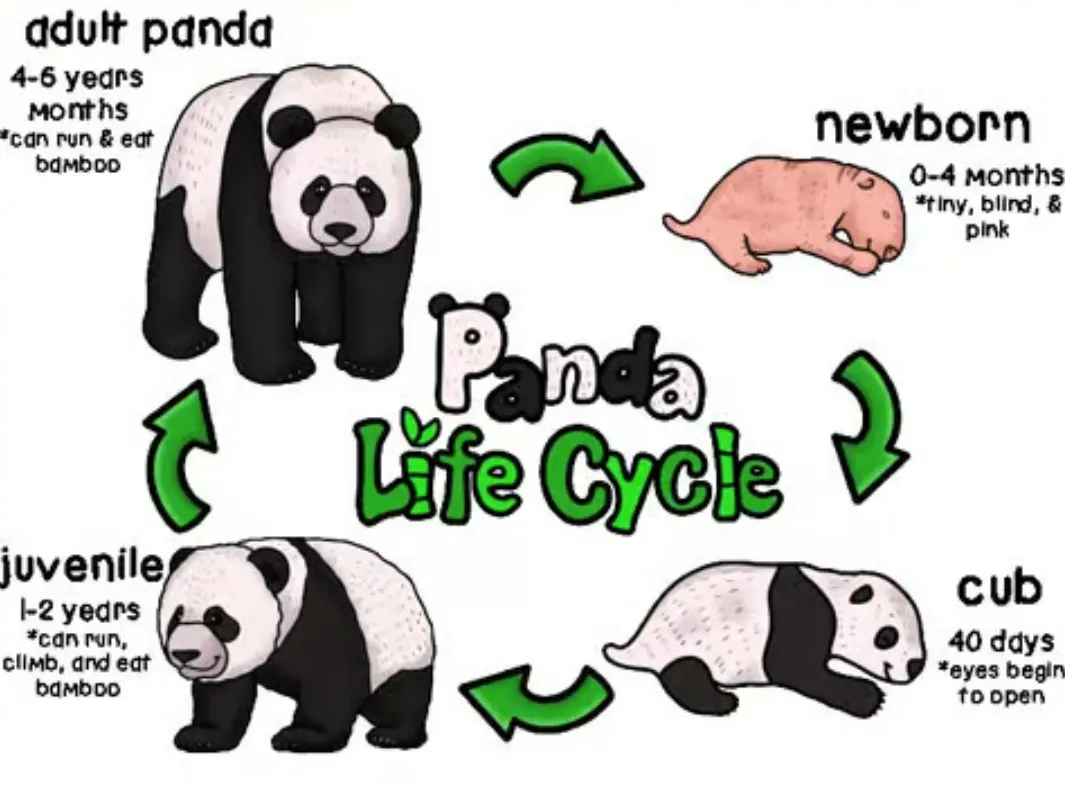
The panda life cycle is the complete journey of a giant panda from a tiny newborn cub to a mature adult that can reproduce and continue the species. In this article, the word panda primarily refers to the giant panda, Ailuropoda melanoleuca, the black-and-white bear native to the temperate bamboo forests of southwest China.
A giant panda has one of the most interesting mammal life cycles because its cubs are born extremely small, blind, pink, and helpless. Over time, the cub develops black-and-white fur, opens its eyes, learns to crawl, starts eating bamboo, and eventually becomes independent.
Adult pandas are mostly solitary animals. They spend much of their day eating bamboo because bamboo is low in energy, and pandas need a large amount of it to survive. The giant panda is currently listed as Vulnerable, with about 1,864 individuals in the wild according to WWF’s species profile.
Q: What are the main stages of the panda’s life cycle?
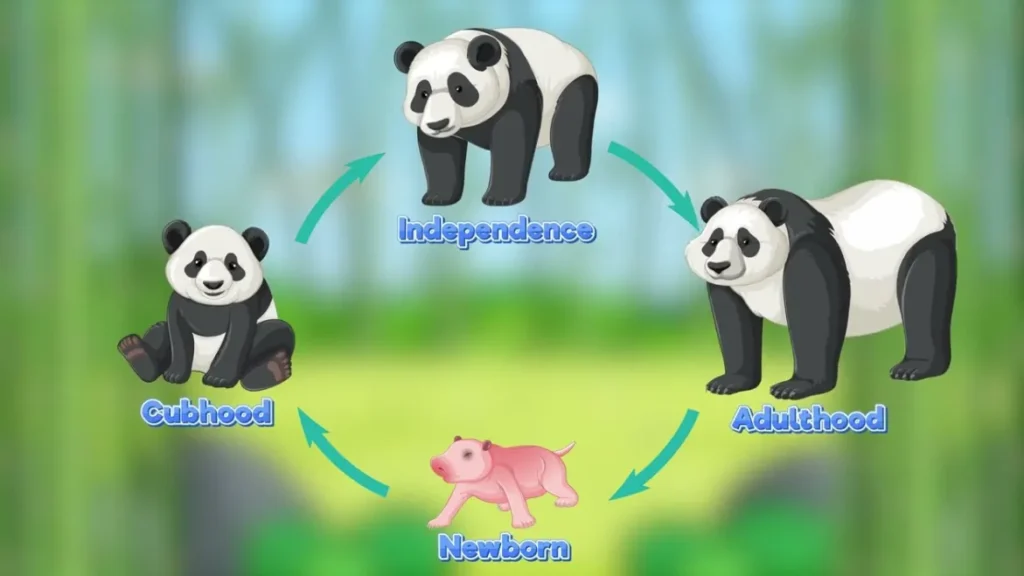
A: The main stages are newborn cub, growing cub, juvenile panda, and adult panda.
Q: How long does a panda cub stay with its mother?
A: A panda cub usually stays with its mother for about 18 months to 2 years, and sometimes longer in natural conditions.
Q: What do pandas eat during their life cycle?
A: Young cubs drink milk first, then gradually learn to eat bamboo, which becomes the main food for adult pandas.
Quick Life Cycle Table
| Life Stage | Approximate Age | Main Features |
| Newborn Cub | Birth to 2 months | Pink, blind, tiny, fully dependent on mother |
| Growing Cub | 2 to 6 months | Fur develops, eyes open, and begins crawling |
| Juvenile Panda | 6 months to 2 years | Starts eating bamboo, learns climbing and survival skills |
| Young Adult | 2 to 5 years | Becomes independent, explores its own range |
| Mature Adult | 5 to 20+ years | Reaches sexual maturity, reproduces, and lives mostly alone |
| Older Panda | 20+ years | Slower movement, lower reproductive ability, and needs a stable habitat |
The History of Their Scientific Naming, Evolution, and Origin
Scientific Name of the Giant Panda
The giant panda is scientifically known as Ailuropoda melanoleuca. The name reflects its unique black-and-white appearance. The species belongs to the family Ursidae, meaning it is a true bear, not a raccoon or cat.
Origin of the Word Panda
The word panda is older than many people think. It was first strongly linked to the red panda, but later became globally famous through the giant panda. Today, most people use “panda” to mean the black-and-white giant panda.
Evolutionary Background
The giant panda evolved as a bear but adapted to a bamboo-based diet. Unlike many other bears, pandas became highly specialized for eating bamboo. Their strong jaw muscles, broad molars, and modified wrist bone help them grip and crush bamboo stems.
Geographic Origin
Wild giant pandas are found mainly in the mountain forests of Sichuan, Shaanxi, and Gansu provinces in China. WWF UK notes that giant pandas live in western China and face threats such as habitat loss, fragmentation, tourism, and infrastructure development.
Their Reproductive Process, Giving Birth, And Rising Their Children
Mating Season
The giant panda reproductive process begins in spring, usually between March and May. During this short breeding season, females become receptive for only a very limited time. This makes panda reproduction naturally difficult.
WWF’s panda life cycle information explains that giant pandas reach sexual maturity at around 5.5 to 6.5 years, females may mate with several competing males, and male-female association usually lasts only 2 to 4 days.
Pregnancy and Birth
The gestation period of a panda can vary widely, often around 95 to 160 days. This variation occurs partly because pandas can undergo delayed implantation, in which the fertilized egg does not immediately attach to the uterus.
Most wild pandas give birth to one cub, although twins can happen. In the wild, raising twins is extremely difficult because the mother usually cannot provide enough care for both cubs.
Care of the Cub
A newborn panda cub is completely helpless. It cannot see, walk, or regulate its body well. The mother keeps the cub warm, nurses it frequently, and protects it inside a den.
Male pandas do not raise the cubs. The mother carries the full responsibility of feeding, cleaning, guarding, and teaching the cub until it is strong enough to survive independently.
Learning Survival Skills
As the cub grows, it begins to crawl, walk, climb, and play. These activities are not just cute behaviors; they are important survival training. Through play and observation, the young panda learns to navigate forest terrain, handle bamboo, and recognize its environment.
Stages of Panda Life Cycle
Stage 1: Newborn Panda Cub
The first stage of the panda’s life cycle begins at birth. A newborn giant panda cub is very small compared with its mother. It is usually pink, blind, hairless, or lightly covered, and completely dependent on maternal care.
At this stage, the cub survives only through the mother’s milk and protection. It cannot crawl properly, cannot open its eyes, and cannot find food on its own. The mother keeps the cub close to her body and responds to its calls.
This stage is very delicate because the cub is vulnerable to cold, injury, and malnutrition. Strong maternal care is essential.
Stage 2: Growing Cub
The second stage begins as the cub becomes stronger. Its black-and-white fur pattern starts becoming clearer. The cub’s eyes gradually open, and it begins to respond more actively to sounds, smells, and touch.
By a few months old, the cub starts crawling and exploring the den area. It still depends heavily on milk, but it becomes more curious about its surroundings.
This stage is important because the cub’s muscles, senses, and coordination develop quickly. The mother may leave for short periods to feed, but she remains highly protective.
Stage 3: Juvenile Panda
The juvenile stage begins when the young panda starts eating small amounts of bamboo while still nursing. This transition is a major milestone in the panda life cycle.
During this stage, the cub learns to climb, walk, roll, play, and feed. It follows the mother and observes how she selects bamboo shoots, leaves, and stems.
A juvenile panda gradually becomes more independent, but it still relies on its mother for safety and learning. This stage usually continues until around 18 months to 2 years.
Stage 4: Adult Panda
The adult stage begins when the panda becomes independent and establishes its own home range. Adult pandas are usually solitary, meaning they spend most of their lives alone except during the breeding season.
A mature adult panda spends many hours eating bamboo every day. It uses scent marks, sounds, and body signals to communicate with other pandas.
By around 5 to 7 years, many pandas are mature enough to reproduce. This final stage completes the panda life cycle, allowing the next generation to begin.
Important Things That You Need To Know
Many people search for panda information using different related terms, but not all of them mean the same thing. For example, red panda, Panda Express near me, Bored Panda, Panda Express menu, and Kung Fu Panda are common search phrases, yet they belong to very different topics.
The red panda is a real animal, but it is not the same species as the giant panda. The red panda, scientifically known as Ailurus fulgens, is listed as Endangered. WWF UK states that red panda numbers are believed to be fewer than 10,000 individuals in the wild, although the exact number is uncertain.
Kung Fu Panda is an animated entertainment franchise inspired by a panda character, not a scientific source about the real panda life cycle. Bored Panda is a media website, while Panda Express menu and Panda Express near me are restaurant-related searches.
So, when learning about the panda life cycle, it is important to focus on the real giant panda, its reproduction, cub development, bamboo diet, habitat, lifespan, and conservation status. These biological facts help readers understand how pandas grow, survive, and contribute to their forest ecosystem.
Their main diet, food sources, and collection process are explained
Main Diet of Pandas
The main diet of the giant panda is bamboo. Although pandas are classified as bears, they eat mostly plant material. Bamboo makes up the bulk of their daily diet.
Pandas may eat bamboo leaves, shoots, and stems depending on the season. Tender shoots are often easier to digest and more nutritious, while stems provide bulk food when other parts are less available.
Other Food Sources
In the wild, pandas may occasionally eat grasses, fruits, small animals, or carrion, but these are not their main foods. Their lives are closely linked to bamboo forests.
Because bamboo is low in calories, pandas need to eat for many hours each day. Their digestive system is still closer to that of a carnivore than a typical herbivore, so they cannot extract energy from bamboo as efficiently as animals like cows or deer.
Food Collection Process
A panda uses its strong jaws, powerful teeth, and modified wrist bone to hold and process bamboo. This wrist bone works almost like a thumb, helping the panda grip bamboo stems.
The panda usually sits while eating. It pulls bamboo toward its mouth, strips the outer parts, bites through stems, and chews leaves or shoots. This feeding behavior is repeated many times throughout the day.
Seasonal Feeding
Pandas move through their habitat depending on the availability of bamboo. Seasonal bamboo growth affects where they feed and how far they travel. Healthy bamboo forests are therefore essential for every stage of the panda life cycle.
How Long Does A Panda Live
The lifespan of a panda depends on whether it lives in the wild or in captivity. Wild pandas face natural challenges such as food shortage, injury, disease, habitat fragmentation, and environmental stress. Captive pandas usually receive veterinary care, regular food, and protected living conditions.
The Smithsonian’s National Zoo estimates that giant pandas live 15 to 20 years in the wild and 30 years in human care, with some zoo pandas reported to live even longer.
- A wild panda’s lifespan is usually shorter because pandas must find food, avoid danger, and survive changing forest conditions.
- Captive panda lifespan is often longer because they receive balanced diets, medical care, and close monitoring from animal experts.
- Young cub survival is a major factor in the panda life cycle. A cub must survive its vulnerable early months before reaching the juvenile stage.
- Mother care strongly affects survival because the mother provides warmth, milk, grooming, and protection.
- Food availability matters because pandas depend heavily on bamboo. If bamboo forests are damaged, pandas may struggle to find enough food.
- Habitat quality affects lifespan by influencing movement, breeding opportunities, and access to safe denning areas.
- Fragmented habitats reduce survival chances because isolated pandas may have fewer mating opportunities and less genetic diversity.
- Older pandas become less active and may spend more time resting, eating slowly, and avoiding long travel.
- Captive breeding programs help protect genetic diversity, especially when wild populations are small or separated.
- A long lifespan does not guarantee easy reproduction because female pandas have a short fertile period each year.
In simple terms, a panda can live a long life when it has enough bamboo, a safe habitat, low disturbance, and proper care. However, the wild environment remains challenging, especially for cubs and isolated populations.
Panda Lifespan in the Wild vs. in Captivity
Panda Lifespan in the Wild
In the wild, a giant panda usually lives around 15 to 20 years. Wild pandas must survive without human help. They depend on bamboo forests, natural dens, seasonal food availability, and safe movement routes.
Wild pandas may face injuries, disease, harsh weather, and difficulty finding mates. Habitat fragmentation can also fragment small populations, making breeding more difficult.
Panda Lifespan in Captivity
In captivity, pandas often live for about 30 years because they receive regular food, health checks, medicine, and protection from predators and habitat stress. Some pandas in human care have reached their mid-30s.
Captive pandas also help scientists understand reproduction, nutrition, behavior, and disease prevention.
Why the Difference Matters
The difference between wild and captive lifespan shows how important habitat safety and healthcare are. However, conservation success should not depend only on zoos. The long-term goal is to protect wild pandas in natural bamboo forests where they can complete their life cycle naturally.
Importance of Panda Life Cycle in this Ecosystem
Pandas Support Bamboo Forest Balance
The giant panda plays an important role in its bamboo forest ecosystem. By feeding on bamboo, pandas influence plant growth patterns and help maintain the natural rhythm of bamboo forest life.
They do not destroy forests when the habitat is healthy. Instead, they are part of a balanced feeding system that has developed over thousands of years.
Pandas Help Protect Other Species
Protecting panda habitat also protects many other animals, birds, insects, and plants that live in the same mountain forests. This makes the panda an umbrella species. When panda forests are protected, the whole ecosystem benefits.
Pandas Indicate Forest Health
A healthy panda population often means the forest has enough bamboo, clean water, suitable shelter, and connected habitat. If pandas decline, it may signal deeper environmental problems.
Pandas Support Conservation Awareness
The panda is one of the world’s most recognized conservation symbols. Its life cycle helps people understand why reproduction, cub survival, habitat protection, and food security are all connected.
WWF notes that habitat loss and fragmentation remain serious threats, even though panda conservation has improved through reserves and habitat protection.
What to do to protect them in nature and save the system for the future
Protect Bamboo Forest Habitat
- Save and restore bamboo forests where pandas live.
- Prevent unnecessary deforestation and land conversion.
- Keep natural feeding areas connected.
Create Safe Wildlife Corridors
- Build and protect forest corridors between panda populations.
- Help isolated pandas find mates.
- Reduce genetic problems caused by separation.
Control Human Disturbance
- Manage tourism carefully in panda habitats.
- Limit roads, railways, and construction near sensitive forest zones.
- Reduce noise and human pressure during breeding seasons.
Support Local Communities
- Help local people earn income without damaging panda forests.
- Promote sustainable farming, forest use, and eco-friendly tourism.
- Make conservation beneficial for both people and wildlife.
Strengthen Research and Monitoring
- Track panda population changes.
- Monitor bamboo growth, disease risk, and climate impacts.
- Use scientific data to improve conservation planning.
Fun & Interesting Facts About Panda Life Cycle
- Panda cubs are born extremely small compared with their mothers.
- Newborn panda cubs are blind and cannot walk at birth.
- Pandas develop their black-and-white pattern gradually after birth.
- Bamboo is the main food of adult giant pandas.
- A panda has a special wrist bone that works like a thumb for gripping bamboo.
- Giant pandas are true bears, even though their diet is mostly plant-based.
- Adult pandas are mostly solitary and meet mainly during the breeding season.
- Female pandas are fertile for only a short time each year, making reproduction difficult.
- Panda mothers raise their cubs alone; males do not participate in parenting.
- Pandas spend many hours eating every day because bamboo is low in energy.
- A young panda learns by watching its mother, especially how to climb and eat bamboo.
- Pandas are conservation icons, helping people care about wildlife and forests.
- Red pandas are not baby giant pandas; they are a separate species.
- Pandas can live longer in captivity due to veterinary care and a stable food supply.
- Protecting pandas also protects forests, water systems, and many other species.
Frequently Asked Questions (FAQs)
Q: What is the panda life cycle?
A: The panda life cycle is the process of growth from newborn cub to adult panda. It includes the newborn stage, growing cub stage, juvenile stage, and mature adult stage.
Q: How long does it take for a panda cub to grow up?
A: A panda cub usually becomes independent at around 18 months to 2 years, but it may take about 5 to 7 years to become fully mature for reproduction.
Q: What does a panda eat during its life cycle?
A: A newborn panda drinks its mother’s milk. As it grows, it starts eating bamboo. Adult pandas eat mostly bamboo shoots, leaves, and stems.
Q: How many babies does a panda have?
A: A panda usually gives birth to one cub, although twins can occur. In the wild, raising twins is difficult because the mother often cannot care for both equally.
Q: Are pandas endangered?
A: The giant panda is no longer officially listed as Endangered; it is currently listed as Vulnerable. However, it still needs strong protection because its wild population is small and habitat threats remain.
Conclusion
The panda life cycle is a remarkable story of survival, growth, and adaptation. From a tiny helpless cub to a strong bamboo-eating adult, every stage depends on maternal care, safe habitat, and a steady supply of bamboo. The giant panda is more than a beautiful animal; it is a symbol of forest conservation and ecological balance.
Although panda conservation has made significant progress, the species remains Vulnerable. Habitat loss, fragmentation, climate pressure, and limited breeding opportunities continue to affect its future. Protecting pandas means protecting bamboo forests, wildlife corridors, local communities, and many other species that share the same ecosystem.
A healthy panda life cycle shows that nature can recover when science, conservation, and human responsibility work together. Saving pandas is not only about one animal; it is about saving an entire living system for future generations.
Also Read: life cycle for dogs





Leave a Reply