
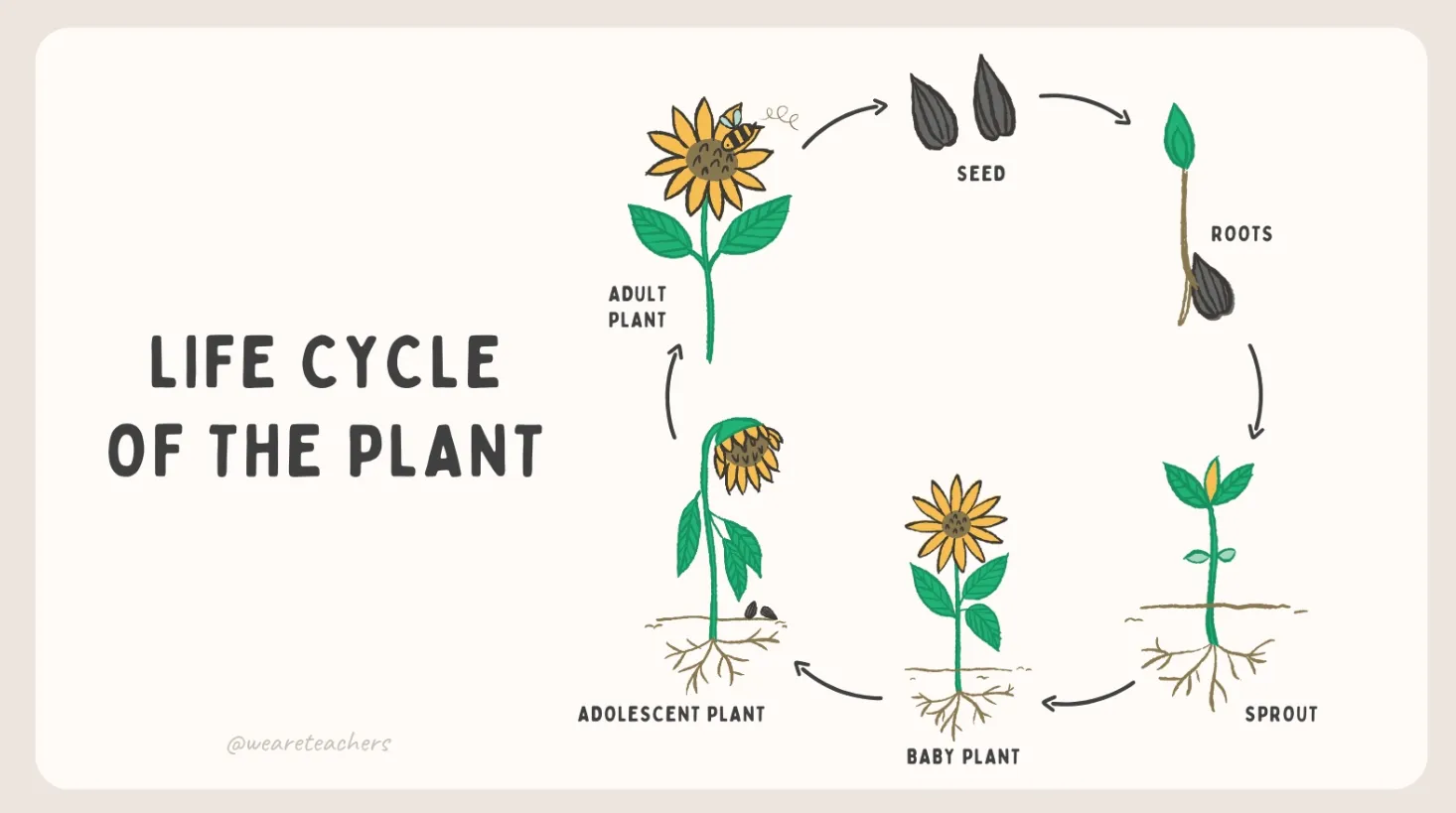
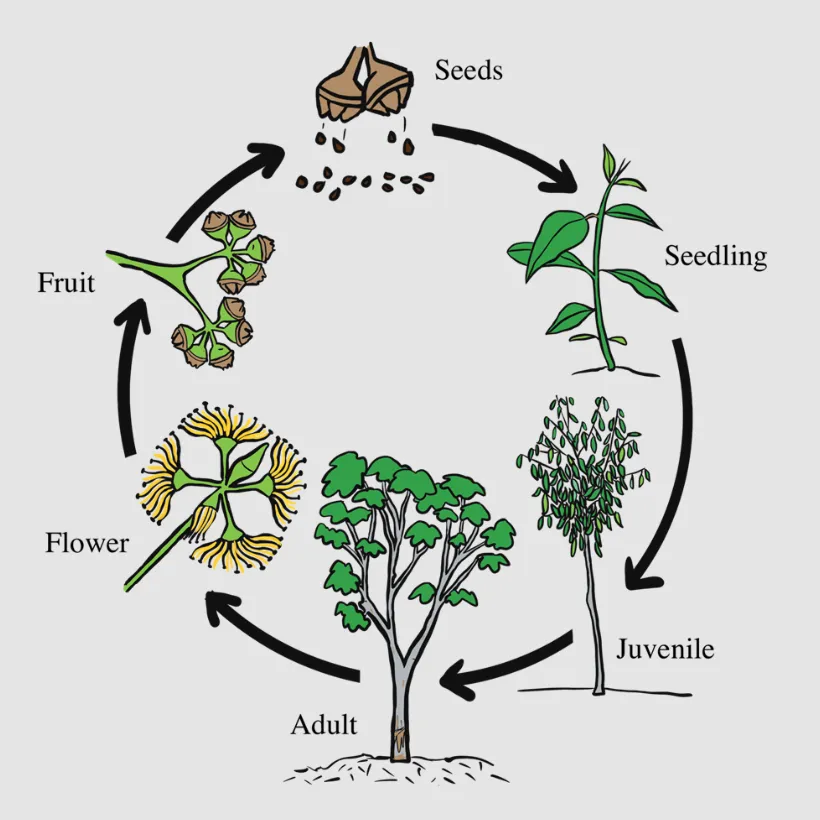
The plant life cycle is the natural journey a plant follows from the beginning of life to maturity, reproduction, and the creation of a new generation. In simple words, it explains how a plant starts as a seed, grows into a seedling, becomes a mature plant, produces flowers or cones, forms seeds, and spreads those seeds to begin the cycle again.
Plants are living organisms in the kingdom Plantae. Most plants make their own food through photosynthesis, using sunlight, water, carbon dioxide, and chlorophyll. Botanists describe plants as multicellular, mostly photosynthetic organisms with cellulose-rich cell walls and life histories that include alternating reproductive generations.
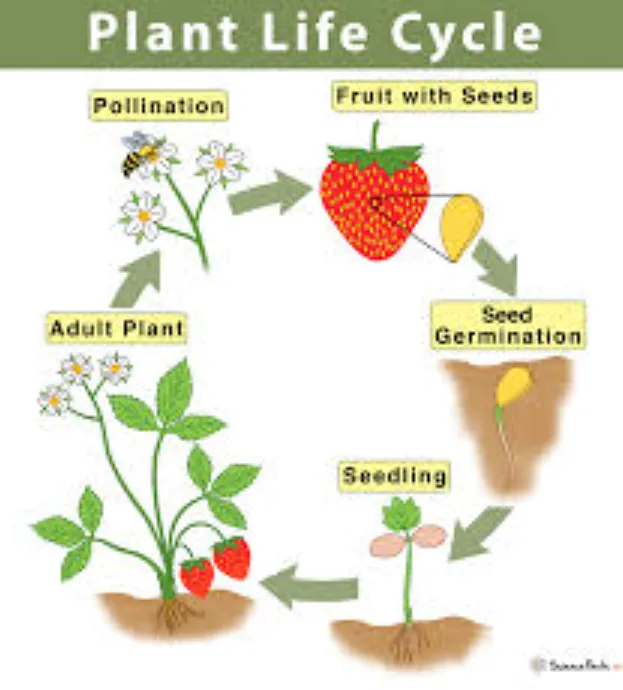
The life cycle is not the same for every plant. A small grass plant may complete its life in a few weeks or months, while large trees can live for hundreds or even thousands of years. Some plants reproduce by seeds, while others reproduce by spores, bulbs, tubers, rhizomes, runners, or cuttings. Flowering plants usually follow a sequence of stages, including germination, growth, flowering, pollination, seed formation, and seed dispersal.
Q: What is the plant life cycle?
A: The plant life cycle is the complete process through which a plant begins as a seed or spore, grows, matures, reproduces, and produces new plants.
Q: What are the main stages of a plant’s life cycle?
A: The main stages are seed, germination, seedling, adult plant, flowering or reproduction, seed formation, and seed dispersal.
Q: Do all plants have the same life cycle?
A: No. Flowering plants, conifers, ferns, mosses, and algae have different life cycles, but all complete a process of growth, reproduction, and renewal.
Quick Life Cycle Table
| Stage | What Happens | Simple Example |
| Seed or Spore | The plant begins life in a protected form. | Bean seed, fern spore |
| Germination | The seed absorbs water and begins to grow roots and shoots. | A seed sprouts after rain |
| Seedling Stage | Young leaves appear, and the plant starts making food. | Small tomato plant |
| Vegetative Growth | Roots, stems, and leaves become stronger. | A plant grows taller |
| Mature Plant | The plant becomes ready for reproduction. | A tree or flowering plant |
| Flowering/Reproduction | Flowers, cones, spores, or vegetative parts form. | Rose flower or pine cone |
| Pollination/Fertilization | Male and female reproductive cells join in seed plants. | Bee moves pollen |
| Seed/Fruit Formation | Seeds develop, often inside fruits. | Mango, apple, pea pod |
| Seed Dispersal | Wind, water, animals, or gravity spread seeds. | Dandelion seeds fly |
| New Cycle Begins | A seed reaches a suitable place and grows again. | New plant appears |
The History Of Their Scientific Naming, Evolution, and Their Origin
Scientific Naming of Plants
Plants are named through binomial nomenclature, a scientific naming system that gives each plant a genus and species name. For example, the scientific names of rice and the mango plant are Oryza sativa and Mangifera indica, respectively.
This system helps scientists, farmers, students, and researchers identify plants clearly across different countries and languages. Common names can vary by region, but scientific names are internationally recognized.
Evolution and Origin of Plants
The origin of plants goes back to ancient aquatic ancestors. Early plant-like organisms lived in water, and over millions of years, some evolved features that helped them survive on land.
Important evolutionary changes included roots for anchorage and water absorption, vascular tissues for transport, seeds for protection, and flowers for efficient reproduction. Britannica notes that plant life histories exhibit an alternation of haploid and diploid generations, an important feature in plant evolution and classification.
Rise of Flowering Plants
Flowering plants, also called angiosperms, became one of the most successful plant groups on Earth. Their success came from flowers, fruits, and strong partnerships with pollinators such as bees, butterflies, birds, bats, and other animals.
Their Reproductive Process, Giving Birth And Rising Their Children
Plants Do Not Give Birth Like Animals
Plants do not “give birth” in the same way animals do. Instead, they reproduce by making seeds, spores, or new plant parts. These seeds or plant parts grow independently when they find the right conditions.
A seed is like a protected baby plant. It contains an embryo, stored food, and a seed coat. When water, air, warmth, and suitable soil are available, the embryo begins to grow.
Sexual Reproduction in Flowering Plants
In flowering plants, reproduction usually begins with pollination. Pollination happens when pollen moves from the male part of a flower, called the anther, to the female part, called the stigma.
This transfer can happen through wind, water, insects, birds, bats, or other animals. The U.S. Forest Service explains that successful pollen transfer leads to fertilization, seed development, and fruit production.
Fertilization and Seed Formation
After pollination, pollen grows a tube down to the ovule. The male reproductive cell joins with the female reproductive cell. This is called fertilization.
FAO describes seed development as beginning after fertilization, when male and female cells unite to form a new diploid organism.
How Plants “Raise” Their Young
Plants do not provide parental care to their young like mammals or birds do. Instead, they support the next generation by producing strong seeds, protective fruits, stored food, and smart dispersal methods.
Some fruits attract animals that eat them and later spread seeds through their droppings. Other plants create light seeds that float in the wind or seeds with hooks that attach to fur, clothes, or feathers.
Stages of Plant Life Cycle
1. Seed Stage
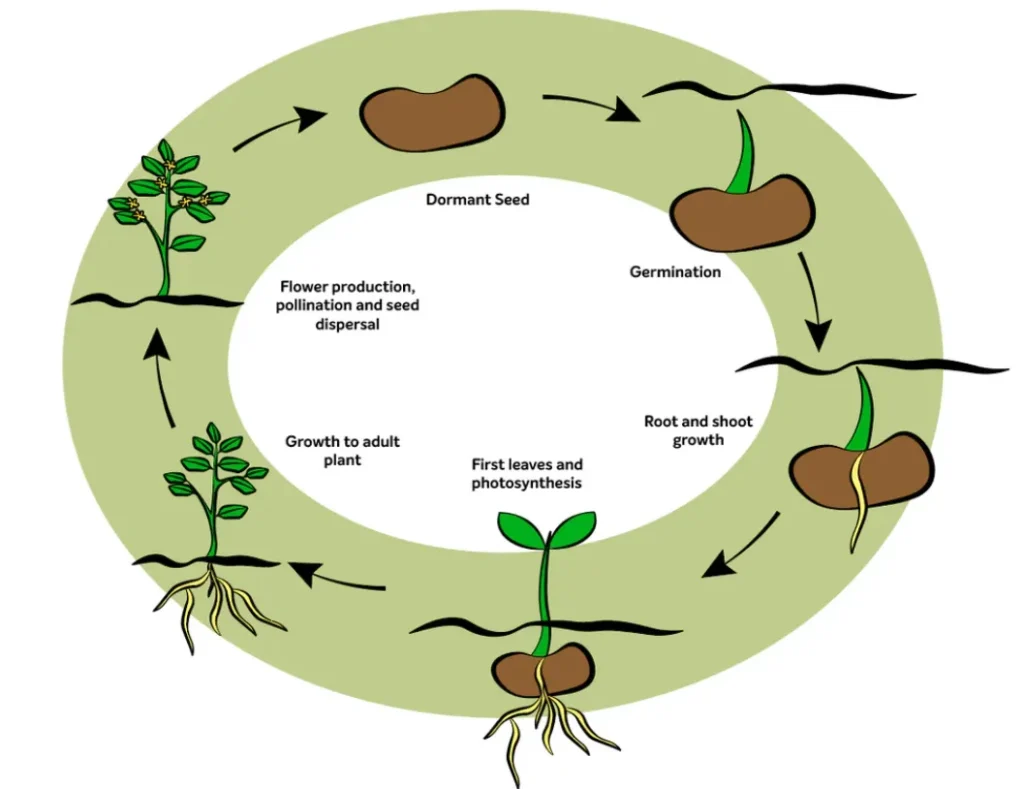
The seed stage is the beginning of life for many plants. A seed contains a tiny plant embryo, a food supply, and a protective outer coat. Seeds may remain inactive for days, months, or even years until conditions become suitable.
This inactive condition is called dormancy. Dormancy protects seeds from sprouting during bad weather, drought, extreme cold, or unsuitable soil conditions.
2. Germination Stage
Germination begins when the seed absorbs water. This process is called imbibition. The seed coat softens, and the embryo starts to grow.
The first root, called the radicle, grows downward into the soil. Then the shoot grows upward toward the light. At this stage, the young plant depends mostly on stored food inside the seed.
3. Seedling and Vegetative Growth Stage
After germination, the plant becomes a seedling. Small leaves open and begin photosynthesis. The roots grow deeper, and the stem becomes stronger.
During the vegetative stage, the plant focuses on building roots, stems, branches, and leaves. This stage is important because a healthy root and leaf system supports future flowering and reproduction.
4. Mature Reproductive Stage
When the plant becomes mature, it enters the reproductive stage. Flowering plants produce flowers, conifers produce cones, and ferns or mosses produce spores.
In flowering plants, pollination and fertilization lead to seed formation. Seeds may be protected inside fruits, pods, capsules, cones, or dry seed heads. After seeds spread and germinate, the plant life cycle begins again.
Their Main Diet, Food Sources, and Collection Process Explained
Plants Make Their Own Food
The main “diet” of a plant is unlike that of animals. Plants do not hunt, chew, or digest food from outside in the same way animals do. Most plants are autotrophs, meaning they make their own food.
They use sunlight, water, and carbon dioxide to produce sugar through photosynthesis. This sugar gives the plant energy for growth, repair, reproduction, and survival.
Main Food Sources of Plants
Plants mainly need:
- Sunlight for energy
- Water for photosynthesis and transport
- Carbon dioxide from the air
- Minerals from soil
- Oxygen for respiration
- Healthy soil microbes that support nutrient cycling
Important minerals include nitrogen, phosphorus, potassium, calcium, magnesium, and iron. These nutrients help plants form leaves, roots, flowers, fruits, proteins, enzymes, and chlorophyll.
How Plants Collect Their Food Materials
Plants collect water and minerals through roots. Tiny root hairs increase the surface area and help absorb dissolved nutrients from the soil.
Leaves collect carbon dioxide through small pores called stomata. Chlorophyll inside the leaves captures sunlight. Then photosynthesis produces glucose, which is transported to different parts of the plant.
Special Feeding Strategies
Not all plants depend only on ordinary photosynthesis and soil nutrients. Carnivorous plants, such as Venus flytraps, capture insects to obtain extra nitrogen. Parasitic plants take nutrients from host plants. These are special adaptations for difficult environments.
Important Things That You Need To Know
The plant life cycle is one of the most important natural systems on Earth because it supports food production, oxygen release, soil protection, climate balance, and biodiversity. Every plant plays a role, whether it is a tiny moss, a garden vegetable, a grass species, or a giant forest tree.
A plant’s life cycle is strongly connected to its environment. Temperature, rainfall, soil quality, sunlight, pollinators, pests, diseases, and human activities can all affect how successfully a plant grows and reproduces.
One important thing to remember is that not all plants reproduce in the same way. Flowering plants usually use flowers, pollen, fruits, and seeds. Ferns and mosses use spores. Some plants also reproduce through vegetative parts such as rhizomes, bulbs, runners, tubers, and cuttings.
Another key point is that plants are not passive objects. They respond to light, gravity, water, touch, temperature, and seasonal changes. Roots grow toward water and nutrients, while shoots grow toward light.
Today, plant conservation has become more important than ever. Kew-linked reporting notes that around 350,000 vascular plant species are already known to science, while many more remain undescribed and may be threatened before they are formally studied.
Understanding the plant, its growth stages, and its reproductive process is not only useful for students. It is also important for gardeners, farmers, environmentalists, and anyone who cares about the future of life on Earth.
How Long Does A Plant Live
The lifespan of a plant depends on its species, environment, care, climate, genetics, disease resistance, and reproductive strategy. Some plants complete their life cycles in a single season, while others live for centuries.
- Annual plants live for one growing season. They germinate, grow, flower, produce seeds, and die within a year. Examples include rice, wheat, maize, sunflower, and many vegetables.
- Biennial plants usually live for two years. In the first year, they grow roots, stems, and leaves. In the second year, they flower, produce seeds, and die. Examples include carrot, beetroot, parsley, and foxglove.
- Perennial plants live for more than two years. Many perennials flower repeatedly over several seasons. Examples include roses, mango trees, banana plants, grasses, and many herbs.
- Short-lived herbs may live only a few weeks or months, especially in harsh seasonal environments.
- Shrubs can live for several years to many decades, depending on climate and pruning.
- Trees often have the longest lifespans. Some trees live for hundreds of years, and a few species can live for thousands of years under suitable conditions.
- Indoor houseplants can live from a few years to several decades if they receive proper water, light, soil, humidity, and care.
- Crop plants are often harvested before they die naturally. For example, leafy vegetables may be harvested during the vegetative stage, while fruit crops are harvested after flowering and fruiting.
- Dormant plants may appear dead during winter or dry seasons, but many survive underground through roots, bulbs, tubers, or rhizomes.
- Stress factors such as drought, poor soil, pests, fungal disease, pollution, overwatering, and root damage can shorten a plant’s lifespan.
In general, a plant’s lifespan can range from a few weeks to thousands of years, making plants one of the most diverse life forms on Earth.
Plant Life Cycle Lifespan in the Wild vs. in Captivity
Lifespan in the Wild
In the wild, a plant grows under natural conditions. It receives sunlight, rain, wind, seasonal temperature changes, and natural soil nutrients. It also faces competition from other plants, grazing animals, insects, disease, storms, drought, fire, and human disturbance.
Wild plants often develop strong survival strategies. Some produce thousands of seeds because only a few will survive. Some grow thorns, toxic chemicals, deep roots, waxy leaves, or underground storage organs.
A wild plant’s lifespan can be short or long, depending on the habitat. Desert plants may grow slowly but survive drought. Forest trees may live for centuries if they avoid fire, logging, disease, and severe storms.
Lifespan in Captivity or Cultivation
For plants, “captivity” usually means life in a garden, greenhouse, farm, nursery, or indoor pot. In these controlled environments, plants may receive regular watering, fertilizer, pruning, pest control, and protection from extreme weather.
Because of this care, many plants live longer in cultivation than they would in the wild. However, some plants may live shorter lives if they are overwatered, placed in poor light, grown in small pots, or exposed to unsuitable temperatures.
Main Difference
The wild offers plants natural freedom but also many risks. Cultivation gives protection but requires correct care. A plant lives best when its natural needs are understood and respected.
Importance of Plant Life Cycle in this Ecosystem
Plants Produce Oxygen and Food
Plants are the foundation of most ecosystems. Through photosynthesis, they release oxygen and produce organic matter. This supports animals, humans, insects, fungi, and microorganisms.
Without plants, food chains would collapse. Herbivores depend directly on plants, and carnivores depend indirectly on plants through herbivores.
Plants Support Biodiversity
A single plant can support many living organisms. Flowers feed bees and butterflies. Fruits feed birds and mammals. Leaves feed insects. Roots support soil organisms and fungi.
The plant life cycle keeps this system active. When plants flower, fruit, drop leaves, and produce seeds, they create food and shelter for countless species.
Plants Protect Soil and Water
Plant roots hold soil together and reduce erosion. Forests and grasses slow rainwater, helping it seep into the ground rather than washing soil away.
Plants also improve soil fertility when dead leaves, roots, and branches decompose. This natural recycling returns nutrients to the ecosystem.
Plants Help Climate Balance
Plants absorb carbon dioxide during photosynthesis. Forests, wetlands, grasslands, and other plant-rich ecosystems help store carbon and regulate local temperatures.
Plants Support Human Life
Humans depend on plants for food, medicine, timber, fiber, fuel, shade, beauty, and mental well-being. Protecting plant life cycles means protecting agriculture, biodiversity, and future survival.
What to Do to Protect Them in Nature and Save the System for the Future
Protect Natural Habitats
- Save forests, wetlands, grasslands, mangroves, and riverbanks from unnecessary destruction.
- Avoid clearing wild plant areas for short-term development without ecological planning.
- Support local conservation zones and protected areas.
Grow Native Plants
- Plant native plants because they support local insects, birds, soil microbes, and wildlife.
- Native plants usually need less water and fertilizer than exotic ornamental plants.
- Use native flowering plants to support pollinators.
Reduce Pollution and Chemical Damage
- Avoid excessive pesticides, herbicides, and chemical fertilizers.
- Use compost, mulching, organic pest control, and responsible farming methods.
- Prevent plastic, industrial waste, and toxic runoff from entering soil and water.
Protect Pollinators
- Bees, butterflies, bats, birds, and other pollinators help many plants reproduce.
- Grow flowering plants across different seasons.
- Avoid spraying pesticides during flowering periods.
Conserve Seeds and Rare Species
- Support seed banks, botanical gardens, and community nurseries.
- Save seeds from local plant varieties.
- Teach children and communities why plant diversity matters for food security and climate resilience.
Fun & Interesting Facts About Plant Life Cycle
- Some seeds can stay dormant for many years before germinating when conditions become suitable.
- Bamboo can grow extremely fast compared with many other plants, especially under ideal conditions.
- Coconut seeds can float in seawater and travel long distances before growing on a new shore.
- Dandelion seeds use wind like tiny parachutes to spread far away from the parent plant.
- Mangrove plants can grow in salty coastal environments where many plants cannot survive.
- Carnivorous plants can trap insects to collect nutrients in poor soils.
- Some plants reproduce without seeds, using rhizomes, bulbs, tubers, runners, or cuttings.
- Flowers are reproductive organs, not just decorations. Their color, smell, nectar, and shape often attract pollinators.
- Fruits are seed carriers. Many fruits are sweet because they attract animals that help spread seeds.
- Roots can communicate with soil fungi, forming partnerships that help plants absorb nutrients more effectively.
- Not all plants need flowers. Ferns and mosses reproduce through spores.
- Plant life cycles support human food systems, from rice and wheat to fruits, vegetables, spices, and medicinal plants.
Frequently Asked Questions (FAQs)
Q: What is the plant life cycle in simple words?
A: The plant life cycle is the process by which a plant starts as a seed or spore, grows into a mature plant, reproduces, and creates new plants.
Q: What are the 4 main stages of a plant’s life cycle?
A: The 4 simple stages are seed, germination, growth, and reproduction. In more detail, the cycle includes seedling growth, flowering, pollination, seed formation, and dispersal.
Q: Why is germination important in the plant life cycle?
A: Germination is important because it is the first active stage of plant growth. Without germination, the seed cannot develop roots, shoots, leaves, or a mature plant body.
Q: Do all plants grow from seeds?
A: No. Many plants grow from seeds, but some reproduce by spores, rhizomes, bulbs, tubers, runners, or stem cuttings.
Q: What helps plants complete their life cycle?
A: Plants need sunlight, water, air, nutrients, suitable temperature, healthy soil, and sometimes pollinators to complete their life cycle successfully.
Conclusion
The plant life cycle is a powerful natural process that sustains ecosystems, keeping them alive, balanced, and productive. From a tiny seed to a mature plant, every stage has a purpose. Germination begins growth; leaves produce food; roots collect water and nutrients; flowers support reproduction; and seeds carry life into the next generation.
Understanding the plant life cycle helps us appreciate how plants feed humans, support wildlife, produce oxygen, protect soil, and maintain a balanced climate. It also teaches us why conservation, native planting, seed saving, and pollinator protection are essential for the future.
Plants may look simple, but their life cycle is deeply intelligent, adaptive, and connected to all living systems. By protecting plants and their habitats, we protect food security, biodiversity, clean air, healthy soil, and the natural world that supports life on Earth.
Also Read: pantry moth life cycle





Leave a Reply