
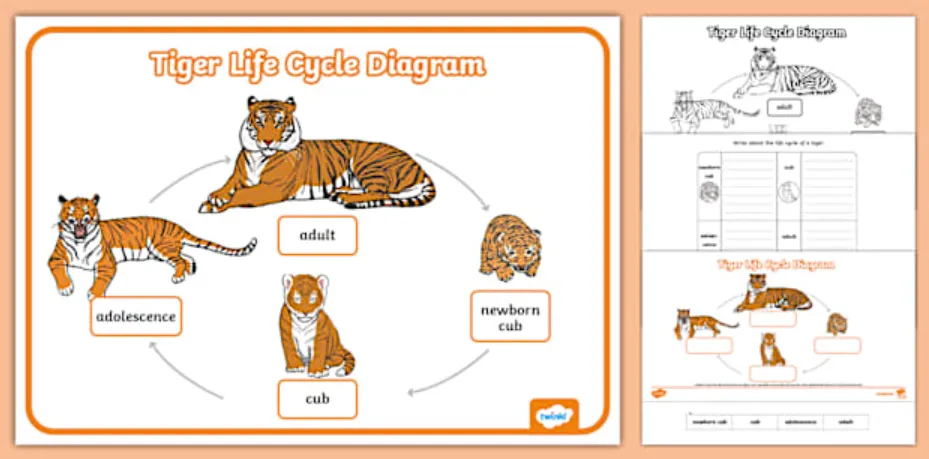
The tiger life cycle is the complete journey of a tiger from birth as a helpless cub to adulthood as one of the strongest predators in nature. A tiger belongs to the species Panthera tigris, the largest living cat species and a powerful apex predator found across parts of Asia.
Tigers are known for their orange coats, black stripes, white bellies, muscular bodies, strong jaws, and silent hunting style. No two tigers have the same stripe pattern, which helps researchers identify individuals in the wild. Tigers live in forests, mangrove swamps, grasslands, tropical areas, and colder regions such as the Russian Far East, depending on subspecies and prey availability.
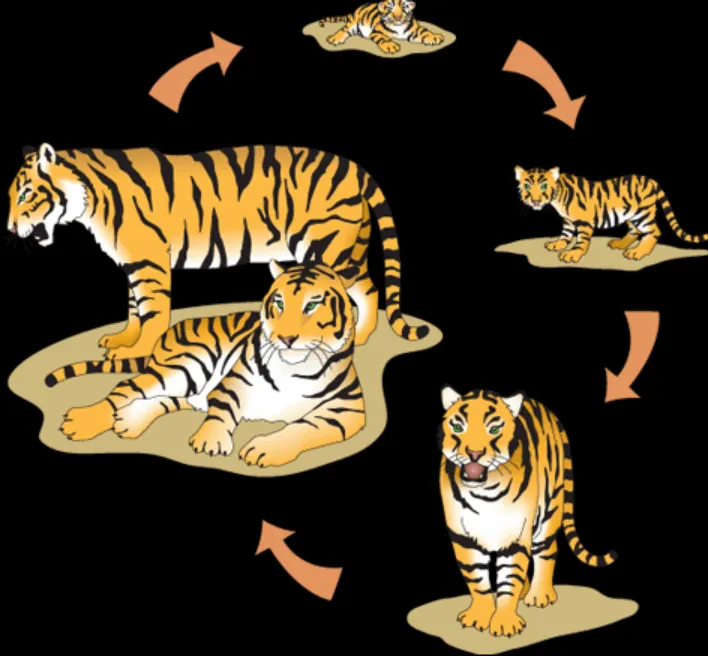
The tiger life cycle usually includes four major stages: cub, juvenile, sub-adult, and adult. Cubs depend fully on their mother; juveniles learn hunting skills; sub-adults begin exploring territory; and adults reproduce and maintain home ranges. Female tigers usually reach sexual maturity at about 3–4 years, while males mature at about 4–5 years.
Quick Answers: Most Common Questions
Q: What are the main stages of the tiger’s life cycle?
A: The main stages are cub, juvenile, sub-adult, and adult tiger.
Q: How long does a tiger cub stay with its mother?
A: A tiger cub usually stays with its mother for about 18–24 months, sometimes longer, until it can hunt and survive independently.
Q: How long do tigers live?
A: Tigers usually live 10–15 years in the wild, while tigers in human care may live up to around 20 years or more in some cases.
Quick Life Cycle Table
| Life Cycle Stage | Approx. Age | Main Features | Survival Need |
| Cub | Birth–6 months | Blind at birth, drinks milk, stays hidden | Mother’s milk, warmth, protection |
| Juvenile | 6–18 months | Learns walking, stalking, playing, and hunting basics | Training from mother |
| Sub-adult | 18 months–3 years | Begins independence and territory search | Safe habitat and enough prey |
| Adult | 3–15 years | Hunts alone, mates, and defends territory | Prey, territory, water, breeding success |
The History of Their Scientific Naming, Evolution, and Origin
Scientific Naming of the Tiger
The scientific name of the tiger is Panthera tigris. Earlier, in 1758, Carl Linnaeus described the tiger as Felis tigris. Later, taxonomists placed it in the genus Panthera, which includes large cats such as lions, leopards, jaguars, and snow leopards.
Meaning of the Name
The word tiger has ancient roots and is linked to the old Greek and Latin forms of tigris. The name became associated with speed, strength, and striking appearance. In modern biology, Panthera tigris clearly separates the tiger from other big cats.
Evolution and Origin
Tigers evolved in Asia and spread across different habitats over time. Fossil and genetic evidence suggest that the tiger lineage has a deep evolutionary connection with other Panthera cats. Early tiger-like fossils have been found in Asia, and modern tiger populations developed through long periods of adaptation to forests, grasslands, wetlands, and cold northern regions.
Living and Extinct Forms
Today, surviving tiger populations include the Bengal tiger, Amur tiger, Sumatran tiger, Indochinese tiger, Malayan tiger, and South China tiger. Some historical tiger populations, including the Caspian, Javan, and Bali tiger, are extinct.
Their Reproductive Process, Giving Birth And Rising Their Children
Mating and Reproductive Age
The tiger reproductive process begins when a mature male and female meet for mating. Tigers are normally solitary, but they come together during breeding. Female tigers usually become mature at 3–4 years, while males often mature at 4–5 years.
Pregnancy and Giving Birth
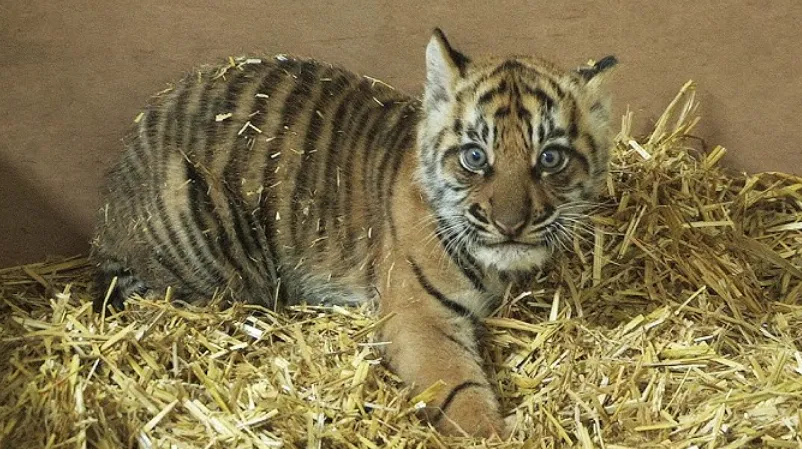
After mating, the female tiger has a gestation period of about 100 days. She usually gives birth in a hidden den, among thick vegetation, in a rocky shelter, or in a quiet forest area. A litter often contains 2–4 cubs, though litter size can vary.
Newborn cubs are blind, weak, and fully dependent on their mother. They cannot hunt, defend themselves, or immediately follow the mother. During this early stage of the tiger’s life cycle, the mother keeps the cubs hidden from predators, rival males, and disturbance.
Raising Tiger Cubs
The mother tiger does almost all the work of raising cubs. She feeds them milk, cleans them, moves them between safe hiding places, and protects them from danger. As cubs grow, they begin eating meat and watching their mother hunt.
Learning Survival Skills
Young tigers learn by play-fighting, stalking, following, and observing. These activities are not just fun; they are training for adult survival. By around 18–24 months, cubs usually learn enough hunting skills to begin independence.
Stages of the Tiger Life Cycle
1. Cub Stage
The cub stage is the first and most vulnerable stage of the tiger’s life cycle. Tiger cubs are born blind and helpless. They depend completely on their mother for milk, warmth, grooming, and protection.
During the first few weeks, cubs stay hidden in dens or thick vegetation. The mother leaves them only when she needs to hunt. Cub mortality is high in the wild due to starvation, disease, predation, floods, fires, and threats from rival male tigers.
2. Juvenile Stage
The juvenile stage begins when cubs grow stronger and start moving with their mother. They begin eating meat, exploring the surroundings, and copying hunting behavior.
At this stage, play becomes very important. Cubs chase each other, wrestle, pounce, and practice stalking. These playful actions develop muscles, reflexes, balance, and hunting instincts.
3. Sub-adult Stage
The sub-adult stage marks the transition from dependence to independence. Young tigers begin traveling more widely and slowly separate from their mother.
Male sub-adults usually move farther away to find their own territory, while females may settle closer to their mother’s range. This stage is risky because the young tiger must avoid adult territorial tigers and find enough prey.
4. Adult Stage
The adult stage is when the tiger becomes fully independent. Adult tigers hunt alone, mark territory, reproduce, and defend their home range. Tigers use scent marking, claw marks, urine spraying, and vocal sounds to communicate territory boundaries.
Important Things That You Need To Know
When learning about the tiger life cycle, it is important to understand that not every search term with the word “tiger” refers to the animal Panthera tigris. Some LSI keywords are useful for search context, but they do not always describe the real tiger species.
For example, white tiger refers to a rare color variation of the Bengal tiger, usually caused by a genetic condition. A white tiger is not a separate species. It still belongs to Panthera tigris, but its pale coat and dark stripes make it visually different.
The Tasmanian tiger is not a true tiger at all. It was a marsupial known as the thylacine, which is now extinct. People used the word “tiger” because of its striped back, not because it was related to big cats.
Terms like Tiger Balm and Onitsuka Tiger are brand-related phrases. Tiger Balm is a pain-relief product, while Onitsuka Tiger is a footwear and fashion brand. They are useful search terms, but they are unrelated to tiger biology.
The phrase tiger lily refers to a flowering plant, not an animal. Similarly, popular culture phrases such as “Tiger King” or “derpy tiger” may attract searches, but they should not be confused with real tiger life-cycle facts.
So, when writing or studying tiger biology, focus on real terms like tiger cub, Panthera tigris, tiger habitat, tiger diet, tiger reproduction, and wild tiger conservation.
Their main diet, food sources, and collection process are explained
Main Diet of Tigers
Tigers are carnivores, meaning they eat meat. Their main food sources are large hoofed animals such as deer, wild boar, buffalo, and other ungulates. Depending on the habitat, tigers may also eat monkeys, smaller mammals, birds, fish, reptiles, or livestock near human settlements.
Hunting Process
Tigers are mainly ambush predators. They do not usually chase prey over long distances. Instead, they use silence, camouflage, patience, and explosive power.
A tiger usually follows this hunting process:
- It detects prey using sight, hearing, and smell.
- It moves silently through grass, forest, or cover.
- It waits for the right moment to attack.
- It pounces quickly and uses strong jaws to bite the neck or throat.
- It drags the prey to a safer place before feeding.
Food Collection and Feeding Behavior
Tigers often hunt at night or during cooler hours. Their striped coat helps them blend into shadows, tall grass, and forest patterns. After making a kill, a tiger may hide the carcass from scavengers and return later to feed again.
A tiger may not eat every day. Instead, it may consume a large amount after a successful hunt and then rest for several days.
How Long Does A Tiger Live
The lifespan of a tiger depends on habitat quality, prey availability, disease, injury, human disturbance, and whether it lives in the wild or in captivity.
- Average wild lifespan: Most wild tigers live around 10–15 years. Some may die earlier because of injuries, hunger, territorial fights, or human conflict.
- Captive lifespan: Tigers in zoos or rescue centers may live around 20 years or sometimes longer because they receive regular food, veterinary care, and protection from wild threats.
- Cub survival is difficult: Many tiger cubs do not survive their first two years. Smithsonian notes that about half of wild tiger cubs may die before reaching age two.
- Territory affects survival: Adult tigers need large areas with enough prey. If the habitat becomes fragmented, survival becomes harder.
- Human conflict reduces lifespan: Tigers near villages, livestock areas, roads, or farms face a higher risk from retaliation, accidents, and capture.
- Poaching remains a major danger: Illegal trade in tiger parts and live tigers continues to threaten tiger survival. TRAFFIC reported that from 2020 to June 2025, more than 573 tigers were seized in trafficking cases, roughly 9 per month.
- Food availability matters: A tiger with enough deer, wild boar, and other prey has a better chance of living longer.
- Mother’s protection is vital: Young cubs survive best when their mother is healthy, experienced, and able to hunt successfully.
In simple terms, a tiger can live a long life only when it has a safe habitat, enough prey, low human pressure, and strong protection from illegal trade.
Tiger Lifespan in the Wild vs. in Captivity
Tiger Lifespan in the Wild
In the wild, a tiger usually lives 10–15 years. Life in nature is challenging because tigers must hunt, defend territory, avoid injury, and survive seasonal changes. Wild tigers also face threats from habitat loss, poaching, and human conflict.
Tiger Lifespan in Captivity
In captivity, tigers may live around 20 years or sometimes longer. They do not need to hunt for food, and they receive medical care. However, captivity does not replace the ecological value of living in the wild. A captive tiger may live longer, but it cannot perform the same role in forests, grasslands, and natural food chains.
Why the Difference Happens
The difference in lifespan between wild and captive tigers stems from the natural and human-made dangers they face. Captive tigers may avoid starvation and territorial fights, but they need proper space, enrichment, ethical care, and expert management to remain healthy.
Which Life Is Better for Conservation?
For conservation, the priority is protecting wild tigers in their natural habitat. Captive breeding can support education or genetic management in some cases, but it cannot replace protected forests, prey recovery, and anti-poaching work.
Importance of the Tiger in this Ecosystem
Tigers Control Prey Populations
Tigers are apex predators, meaning they sit at the top of the food chain. By hunting deer, wild boar, and other prey animals, they help control herbivore populations. Without predators, prey numbers can increase to the point of damaging vegetation.
Tigers Protect Forest Balance
When prey populations remain balanced, forests can regenerate better. Healthy vegetation supports birds, insects, reptiles, smaller mammals, and soil organisms. In this way, the tiger indirectly supports many species.
Tigers Indicate Ecosystem Health
A healthy tiger population usually indicates that the ecosystem has enough prey, water, and forest cover, and experiences low disturbance. That is why tigers are often considered an indicator of biodiversity health. The Global Tiger Forum also describes the wild tiger as a broad indicator for biodiversity and human well-being.
Tigers Support Conservation of Other Species
Protecting tiger habitat also protects elephants, leopards, deer, birds, reptiles, wetlands, forests, and local watersheds. Tiger reserves often become safe homes for many species, not just tigers.
Tigers Support Human Communities
Healthy tiger landscapes can support eco-tourism, forest protection, climate regulation, clean water, and local employment when conservation includes local communities and benefits both people and wildlife.
What to do to protect them in nature and save the system for the future
1. Protect Tiger Habitats
- Save forests, grasslands, mangroves, and wildlife corridors.
- Stop illegal logging and destructive land conversion.
- Keep tiger landscapes connected so young tigers can disperse safely.
2. Stop Poaching and Illegal Trade
- Strengthen anti-poaching patrols.
- Use camera traps, tracking technology, and intelligence-based enforcement.
- Reduce demand for tiger skins, bones, teeth, claws, and live cubs. WWF identifies trade in tiger parts and live cubs as a major threat to wild tiger survival.
3. Reduce Human-Tiger Conflict
- Improve livestock protection.
- Give fair compensation for livestock loss.
- Educate communities living near tiger habitats.
- Build early-warning and rapid-response systems.
4. Restore Prey Populations
- Protect deer, wild boar, buffalo, and other prey animals.
- Stop illegal hunting of prey species.
- Maintain healthy water sources and vegetation.
5. Support Science-Based Conservation
- Use camera traps, scat DNA, and field monitoring.
- Fund trained forest guards and conservation teams.
- Support local communities as conservation partners, not outsiders.
Fun & Interesting Facts About the Tiger
- Tigers are the largest living cats in the world.
- Every tiger has a unique stripe pattern, similar to a human fingerprint.
- Tigers are excellent swimmers and can cross rivers and lakes.
- Unlike many cats, tigers often enjoy water and may use it to cool down.
- A tiger’s roar can travel a long distance through forest areas.
- The Amur tiger is usually the largest tiger form, while the Sumatran tiger is the smallest living tiger form.
- White tigers are not a separate species; they are color variants.
- Tigers are mostly solitary, except during mating or when mothers raise cubs.
- Tiger cubs learn survival skills through play.
- A tiger may hide its kill and return later to eat again.
- The Bengal tiger is one of the most numerous tiger populations today.
- Tigers use scent, scratches, urine marking, and vocal sounds to communicate territory.
Frequently Asked Questions (FAQs)
Q: What is the tiger’s life cycle?
A: The tiger life cycle is the journey from newborn cub to juvenile, sub-adult, and adult tiger. It includes birth, growth, hunting practice, independence, reproduction, and territory defense.
Q: How many stages are in the tiger’s life cycle?
A: There are usually four main stages: cub, juvenile, sub-adult, and adult.
Q: What do tiger cubs eat?
A: Newborn tiger cubs drink their mother’s milk. As they grow, they begin eating meat from their mother’s kills.
Q: When do tiger cubs leave their mother?
A: Tiger cubs usually begin independence at around 18–24 months, though some may stay close to the mother longer depending on conditions.
Q: What do adult tigers eat?
A: Adult tigers mainly eat deer, wild boar, buffalo, and other large prey. They may also eat smaller animals when large prey is unavailable.
Q: Are tigers endangered?
A: Yes. Tigers are globally considered Endangered, mainly because of habitat loss, prey decline, poaching, and illegal wildlife trade.
Q: How many wild tigers are left?
A: The Global Tiger Forum announced an estimate of about 5,574 wild tigers in 2023, showing recovery in some countries but continued danger in others.
Conclusion
The tiger life cycle is a powerful story of survival, learning, independence, and ecological importance. From a blind cub hidden in a den to a strong adult predator ruling its territory, every stage of a tiger’s life depends on healthy habitat, enough prey, and protection from human threats.
Tigers are not only beautiful animals; they are essential guardians of forest balance. By controlling prey populations and protecting biodiversity through their presence, they help maintain stronger ecosystems. However, tigers still face serious risks from habitat loss, poaching, illegal trade, and human-wildlife conflict.
Saving the tiger means saving forests, rivers, prey animals, and the future of many connected species. A world with wild tigers is a world with healthier ecosystems, stronger conservation values, and a deeper respect for nature.
Also Read: plant of life cycle






Leave a Reply