
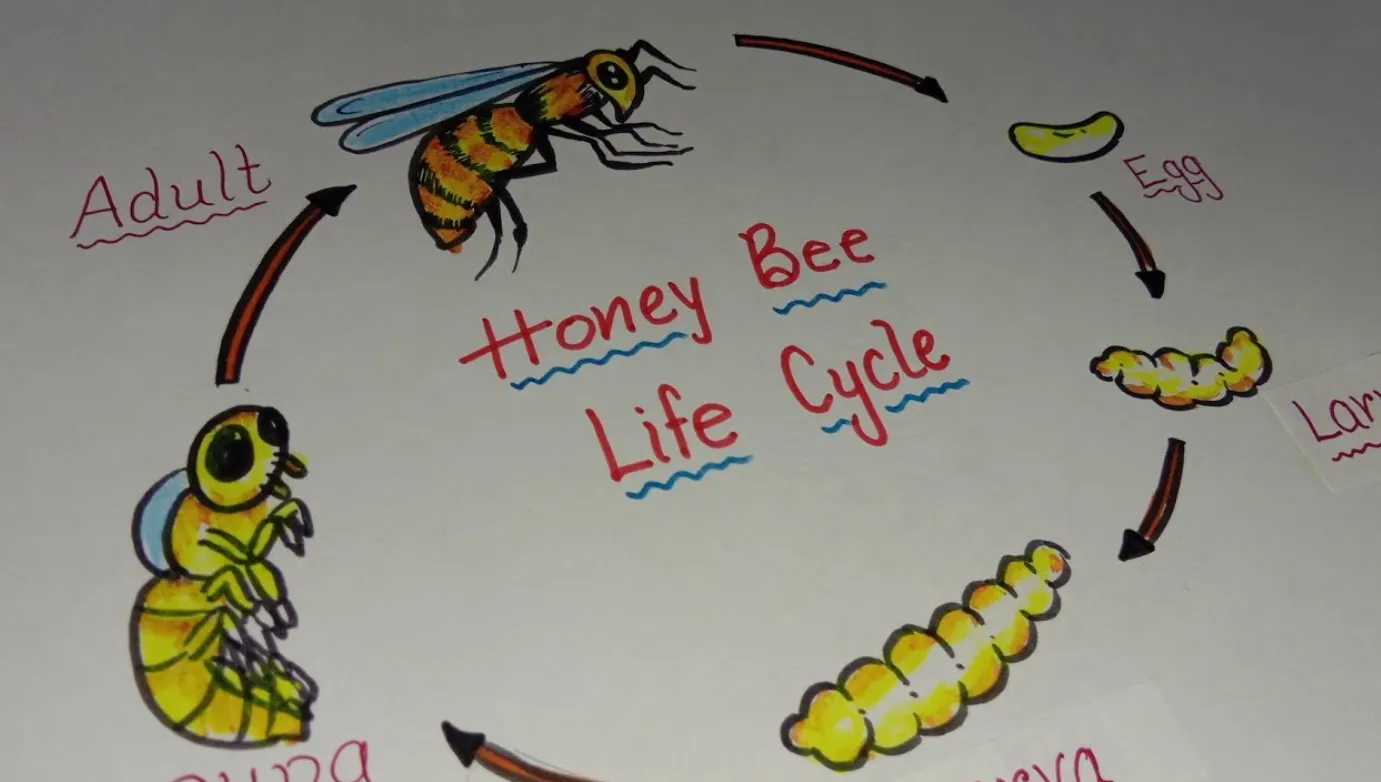
The honey bee’s life cycle is one of the most amazing natural systems on Earth. A tiny egg, smaller than a grain of rice, can grow into a queen honey bee, a worker, or a drone, depending on feeding, genetics, and colony needs. Inside a healthy honey bee hive, every stage has a purpose. Eggs become larvae, larvae become pupae, and pupae finally emerge as adult bees that help the colony survive.
The best-known species is the western honey bee, Apis mellifera. It is valued worldwide for honey, beeswax, and pollination. Scientific sources describe honey bees as complete metamorphosis insects, meaning they pass through four clear stages: egg, larva, pupa, and adult. Workers usually develop in about 21 days, queens in about 16 days, and drones in about 24 days.
Q: What are the four stages in the life cycle of the honey bee?
A: The four stages are egg, larva, pupa, and adult bee.
Q: How long does a honey bee take to become an adult?
A: A worker bee usually takes about 21 days, a queen about 16 days, and a drone about 24 days.
Q: Why is the queen honey bee important in the life cycle?
A: The queen honey bee lays the eggs that keep the colony alive and growing.
Quick Life Cycle Table
| Life cycle stage | What happens inside the hive | Average time | Why it matters |
| Egg | The queen honey bee lays one egg in a wax cell | About 3 days | This is the starting point of every new bee |
| Larva | Nurse bees feed the young larvae with rich food | About 5 to 6 days | Nutrition helps decide future strength and caste |
| Pupa | The cell is capped, and the bee develops wings, legs, eyes, and body parts | About 7 to 14 days | The larva changes into an adult form |
| Adult worker | The bee emerges and begins hive duties | About 21 days total | Workers clean, feed, build, guard, and forage |
| Adult queen | A queen emerges faster than other castes | About 16 days total | She becomes the main egg layer |
| Adult drone | Male bees emerge from larger cells | About 24 days total | Drones mate with queens from other colonies |
This table shows that the honey bee’s life cycle is more than just simple growth. It is a perfectly timed colony system. Each stage supports the next stage, and the whole honey bee hive depends on balance, food, temperature, and worker care
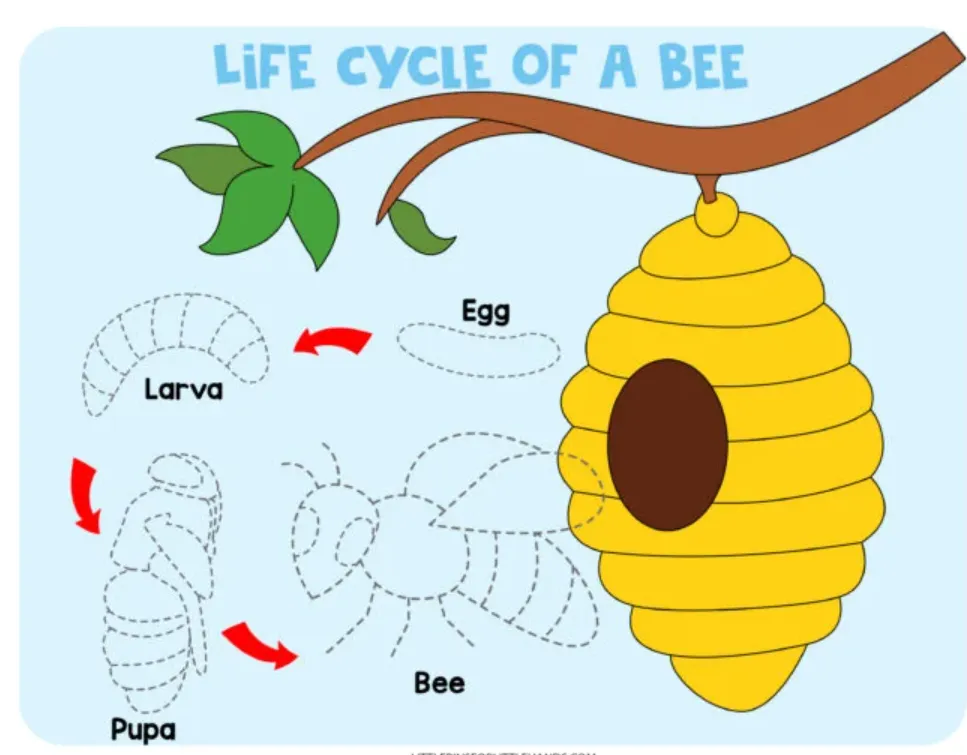
Important Things That You Need To Know
Before studying the full life cycle of the honey bee, it helps to understand a few related search terms and natural facts. The term honey bee usually refers to social bees that live in colonies, make wax comb, store honey, and care for young bees together. The most famous species is the western honey bee, or Apis mellifera, which is widely managed for pollination and honey production. Britannica describes it as an economically important bee species valued for both pollination and hive products.
A honey bee hive is not just a nest. It is a living system in which eggs, larvae, food storage, temperature control, cleaning, defense, and reproduction occur simultaneously. The queen lays eggs, nurse bees feed young bees, wax bees build comb, guard bees protect the entrance, and foragers collect nectar, pollen, water, and plant resins.
People often search for “bumble bee vs honey bee” because both visit flowers, but their life histories differ. Bumble bees usually have annual colonies, while honey bee colonies are perennial, meaning a healthy colony can survive across seasons with stored honey and a long-lived queen.
The term queen honey bee is also important because the queen controls colony growth through egg laying and chemical signals. Other terms, such as “honey bee supply companies united states,” are common in beekeeping searches because beekeepers need hive boxes, frames, protective clothing, feeders, and tools for colony health. Even honey bee stamps appear in searches because bees are often used in art, education, conservation campaigns, and postal designs to represent nature and pollination.
The History of Their Scientific Naming
The scientific name of the western honey bee is Apis mellifera. This name was given by Carl Linnaeus in 1758, during the early period of modern biological classification. GBIF lists Apis mellifera Linnaeus, 1758 as the accepted scientific name.
Important points about the naming history:
• Apis is the genus name. It comes from Latin and means bee.
• Mellifera means honey-bearing or honey-carrying, which describes the bee’s connection with honey production.
• The full scientific name is written as Apis mellifera Linnaeus, 1758.
• Older or related names, such as Apis mellifica, appear in some taxonomy records as synonyms or historical usage. NCBI also lists Apis mellifica as another name associated with the species.
• The species belongs to Animalia, Arthropoda, Insecta, Hymenoptera, Apidae, and Apis.
This scientific naming matters because common names can vary by country. Some people say honey bee, others say European honey bee or western honey bee. The scientific name gives researchers, beekeepers, and readers one clear identity.
Their Evolution And Their Origin
The origin of honey bees is a fascinating subject because bees are closely linked to the rise of flowering plants. Bees are believed to have evolved from ancient wasp-like ancestors. Unlike those ancestors, which hunted other insects, early bees shifted toward collecting pollen and nectar from flowers. This change helped create one of the most important partnerships in nature: flowers feeding bees, and bees helping flowers reproduce through pollination. The Museum of the Earth explains that bees evolved from ancient predatory wasps that lived around 120 million years ago.
The origin of the western honey bee, Apis mellifera, has been debated for many years. Older ideas suggested Africa or the Middle East. Newer genomic research has found strong support for an Asian origin, followed by expansions into Africa and Europe. A Science Advances study based on 251 genomes from 18 native subspecies supported an Asian origin with several major expansions into African and European lineages.
Over time, Apis mellifera adapted to a wide range of climates. Some lineages became better suited to dry regions, while others adapted to colder temperate zones. This ability to adjust helped the western honey bee become one of the most successful pollinators in human agriculture.
Today, humans manage honey bees almost worldwide. Still, their evolutionary success depends on ancient traits: social living, wax comb building, flower memory, communication, and the ability to store honey for difficult seasons.
Their main food and its collection process
The main food of a honey bee colony comes from flowers. Bees collect nectar, pollen, water, and sometimes plant resins. Each food source has a different role in the honey bee hive.
• Nectar gives bees carbohydrates. Forager bees suck nectar from flowers and store it in a special honey stomach. Back inside the hive, nectar is passed to house bees. Enzymes begin breaking down sugars, and bees fan their wings to reduce moisture. Over time, nectar becomes honey.
• Pollen gives bees protein, fats, vitamins, and minerals. Worker bees pack pollen into baskets on their hind legs and carry it back to the hive. Pollen is especially important for larvae and young nurse bees.
• Royal jelly is produced by nurse bees and fed to young larvae. Larvae selected to become queens receive rich queen food for a longer period, which supports queen development.
• Water helps cool the hive, dilute food, and maintain colony balance.
• Plant resin is collected and turned into propolis, a sticky material bees use to seal cracks and protect the hive.
The Honey Bee Health Coalition notes that nutrition is central to honey bee health, and poor nutrition can interact with pesticides and disease pressure.
This collection process also supports pollination. As bees move from flower to flower, pollen sticks to their bodies and gets transferred between blooms. That is why feeding behavior and ecosystem health are directly connected.
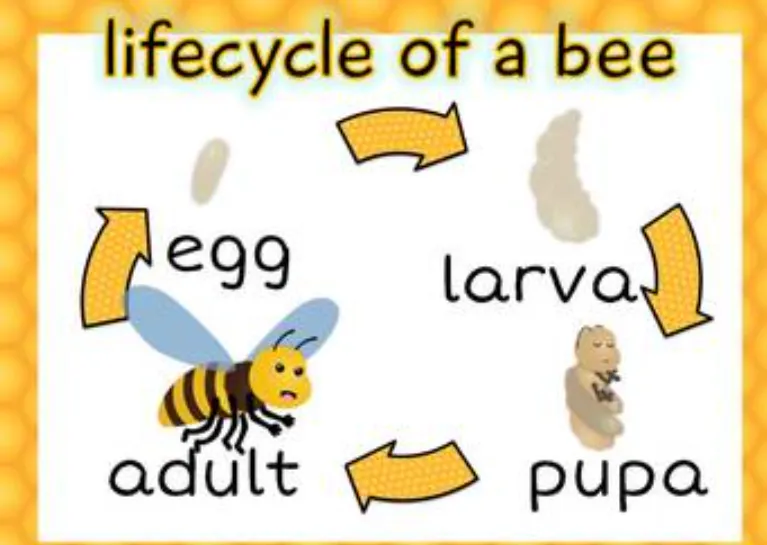
Their life cycle and ability to survive in nature
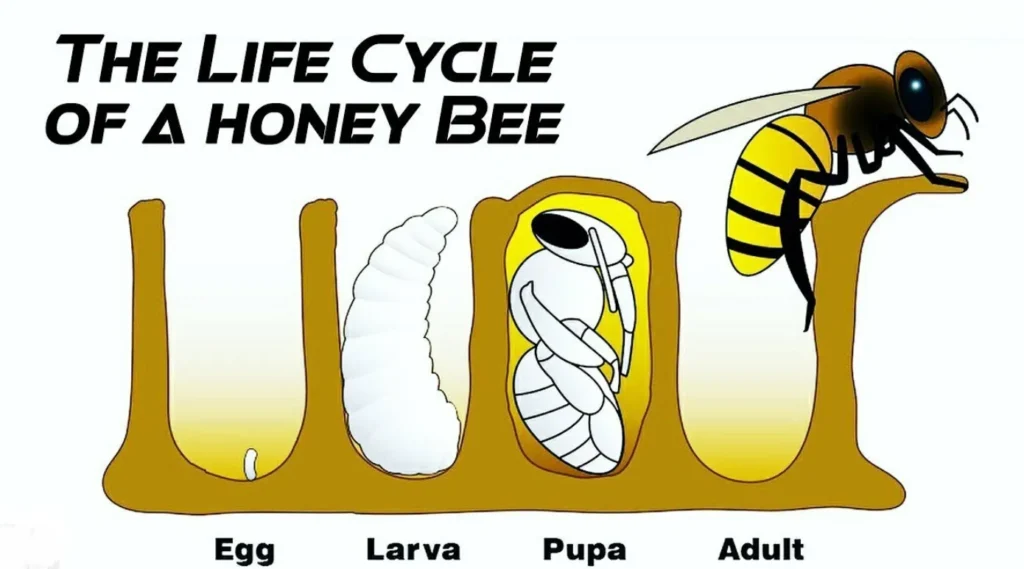
Egg stage
The life cycle of the honey bee begins when the queen honey bee lays an egg inside a wax cell. Each egg stands upright at first and slowly leans as it develops. After about three days, the egg hatches into a larva.
The queen can lay fertilized eggs that become female workers or queens. She can also lay unfertilized eggs that become male drones. This system helps the colony adjust to seasonal needs.
Larva stage
The larva looks like a small white grub. It does not forage or care for itself. Nurse bees feed it many times each day. At this stage, food quality is extremely important. A larva that receives queen-level feeding can develop into a queen honey bee, while most female larvae become workers.
Pupa stage
Once the larva has grown enough, worker bees cap the cell with wax. Inside the sealed cell, the larva undergoes pupation. During this stage, the bee develops wings, legs, eyes, antennae, and body hair.
Adult stage and survival
When development is complete, the adult bee chews through the wax cap and enters hive life. Survival in nature depends on teamwork. Workers keep the brood warm, clean the hive, defend the entrance, feed larvae, and collect food.
A colony survives because it acts almost like one body. Honey stores help bees live through cold or flowerless seasons. Social behavior, food storage, nest defense, and temperature control make honey bees strong survivors in many environments.
Their Reproductive Process and raising their children
The reproductive process of honey bees centers on the queen, drones, and worker care. A honey bee colony does not raise young casually. It raises them through an organized system inside the honey bee hive.
• The queen honey bee leaves the hive for mating flights early in her adult life.
• She mates with multiple drones in the air, often away from her own colony.
• After mating, she stores sperm in her body and can use it for years.
• Fertilized eggs become female bees, which may become workers or queens.
• Unfertilized eggs become male drones.
• Worker bees are usually non-reproductive females, but they do almost all child care in the colony.
• Nurse bees feed larvae, clean brood cells, regulate temperature, and protect developing bees from stress.
• Queen larvae are raised in special queen cells and receive richer feeding.
• Drone brood develops in larger cells and takes longer than worker brood.
Penn State Extension notes that queens have the shortest development period among honey bee castes, with about 16 days from egg to adult queen.
Raising young bees requires food, warmth, clean wax cells, and thousands of feeding visits. If the colony lacks pollen, nectar, or healthy nurse bees, brood development becomes weak. That is why a strong colony is not judged only by the queen. The quality of the whole nursing system is judged by it.
The importance of them in this Ecosystem
Pollination and plant reproduction
The honey bee is one of the best-known pollinators in the world. When bees collect nectar and pollen, they move pollen grains between flowers. This helps many plants produce fruit, seeds, and the next generation.
The western honey bee is especially important in agriculture because it can be managed in large colonies and moved to crop fields. USDA ARS says honey bees are a critical link in United States agriculture and that about one mouthful in three in the human diet directly or indirectly benefits from honey bee pollination.
Food system support
Honey bees help pollinate fruits, nuts, berries, vegetables, and seed crops. USDA sources have reported that managed honey bee pollination adds billions of dollars in value to United States agriculture each year.
Biodiversity and wild plants
Honey bees also visit many wild plants. A global study found that Apis mellifera is a frequent floral visitor in natural habitats, although its role can vary by region and Ecosystem.
Hive products
Beyond pollination, honey bees produce honey, beeswax, propolis, and royal jelly. These hive products have cultural, economic, and practical value.
Balance with native pollinators
Honey bees are important, but they are not the only pollinators. Native bees, butterflies, flies, beetles, and other insects also support ecosystems. A healthy future needs both managed honey bees and wild pollinators.
What to do to protect them in nature and save the system for the future
Protecting honey bees means protecting food, flowers, soil, water, farms, and wild habitats. Current research and conservation groups point to several major threats, including Varroa mites, viruses, pesticide exposure, poor nutrition, habitat loss, and climate stress. USDA ARS reported in 2025 that high levels of viruses associated with miticide-resistant Varroa mites were linked to recent honey bee colony collapses in sampled United States operations.
• Plant more nectar and pollen-rich flowers across seasons.
• Avoid removing every wildflower from gardens, roadsides, and field edges.
• Reduce unnecessary pesticide use, especially during bloom time.
• Choose pollinator safer pest control methods whenever possible.
• Keep flowering plants free from pesticide drift.
• Provide clean shallow water sources for bees.
• Support local beekeepers who follow healthy hive management.
• Protect hedgerows, meadows, orchards, and native flowering plants.
• Learn the difference between a bumblebee and a honeybee so both can be protected.
• If keeping bees, monitor Varroa mites regularly and use science-based control methods.
• Avoid moving diseased colonies near healthy colonies.
• Buy supplies from trusted sources, including reliable honey bee supply companies in the United States, when working with managed hives.
• Teach children and communities why bees matter.
• Support policies and farming practices that protect pollinators.
The EPA also advises best management practices to reduce pesticide exposure and protect bees and other pollinators.
Frequently Asked Questions (FAQs)
Q: What is the life cycle of the honey bee?
A: The life cycle of the honey bee has four stages: egg, larva, pupa, and adult. Each stage happens inside the honey bee hive and depends on worker care.
Q: How many days does a worker honey bee take to develop?
A: A worker honey bee usually develops in about 21 days from egg to adult.
Q: How long does a queen honey bee take to develop?
A: A queen honey bee usually develops faster than workers and emerges in about 16 days.
Q: What does a honey bee larva eat?
A: Honey bee larvae are fed by nurse bees. Young larvae receive glandular food, while developing worker and drone larvae also receive food made from pollen and nectar.
Q: What is the difference between a bumblebee and a honeybee?
A: In simple terms, bumblebee vs. honeybee differences include colony life, body shape, honey storage, and seasonal survival. Honey bee colonies can survive across seasons, while many bumble bee colonies are annual.
Q: Why is the western honey bee important?
A: The western honey bee, or Apis mellifera, is important because it supports pollination, honey production, beeswax production, and agriculture in many parts of the world.
Q: What is inside a honey bee hive?
A: A honey bee hive contains wax comb, brood cells, honey stores, pollen stores, worker bees, drones during the breeding season, and usually one queen.
Q: Why do people search for honey bee stamps?
A: People search for honey bee stamps because bees are often used in postal art, education, collection themes, conservation messages, and nature awareness designs.
Conclusion
The honey bee’s life cycle is a beautiful example of order, teamwork, and survival in nature. From a small egg to a hardworking adult, every stage supports the strength of the colony. The queen honey bee lays the foundation, nurse bees raise the young, workers protect and feed the hive, and foragers connect flowers with food production.
The western honey bee, or Apis mellifera, is important not only because it makes honey, but because it helps pollinate crops and wild plants. A healthy honey bee hive supports agriculture, biodiversity, and natural balance.
But honey bees also face real pressure from mites, disease, pesticides, poor nutrition, and habitat loss. Protecting them starts with simple choices: planting flowers, reducing the use of harmful chemicals, supporting responsible beekeeping, and respecting pollinators in nature. When we protect honey bees, we protect a living system that quietly supports our food, gardens, and future.
Also Read: life cycle of fungal





Leave a Reply