
The ladybird’s life cycle is one of the most interesting natural stories in the insect world. A ladybird, also called a ladybird beetle, ladybug, or lady beetle, is not a true bug. It belongs to the beetle family Coccinellidae under the order Coleoptera.
These small, round insects are loved for their bright colors, but their true value lies far deeper than beauty. Many ladybirds protect plants by eating aphids, mites, scale insects, whiteflies, insect eggs, and other small pests. Both larvae and adults can feed on pests, making them useful in gardens, farms, orchards, and natural habitats.
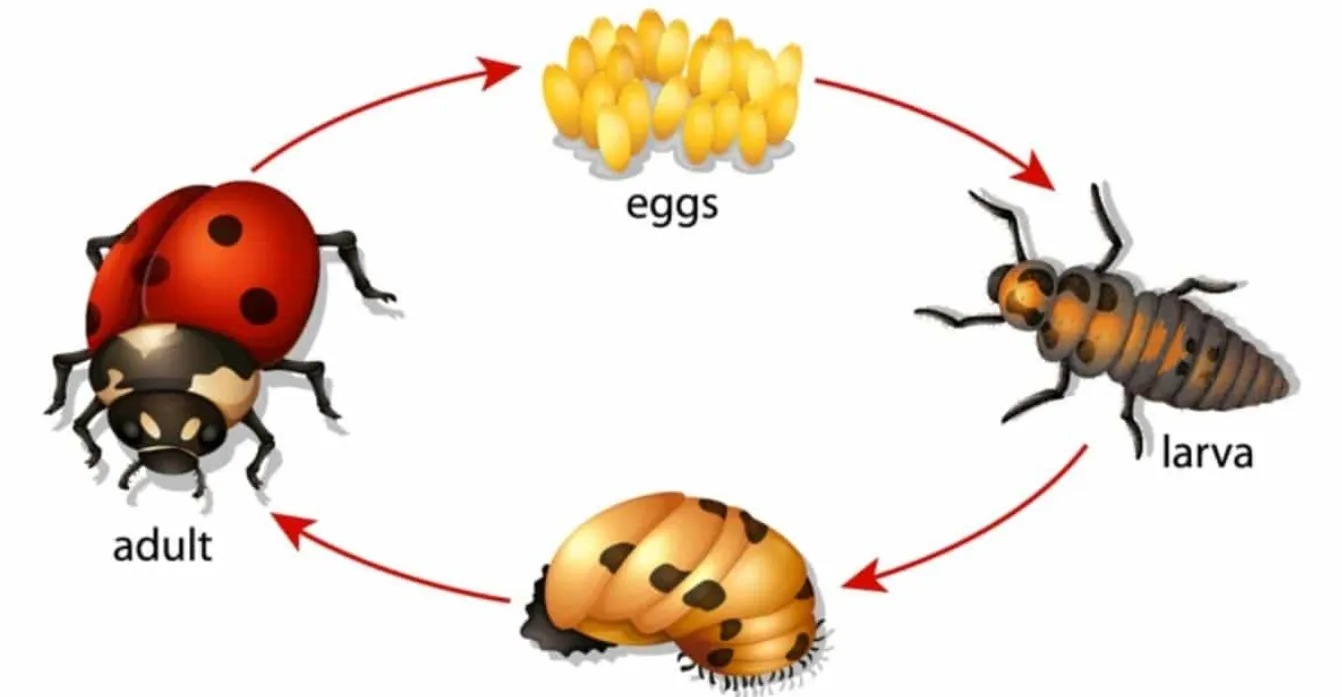
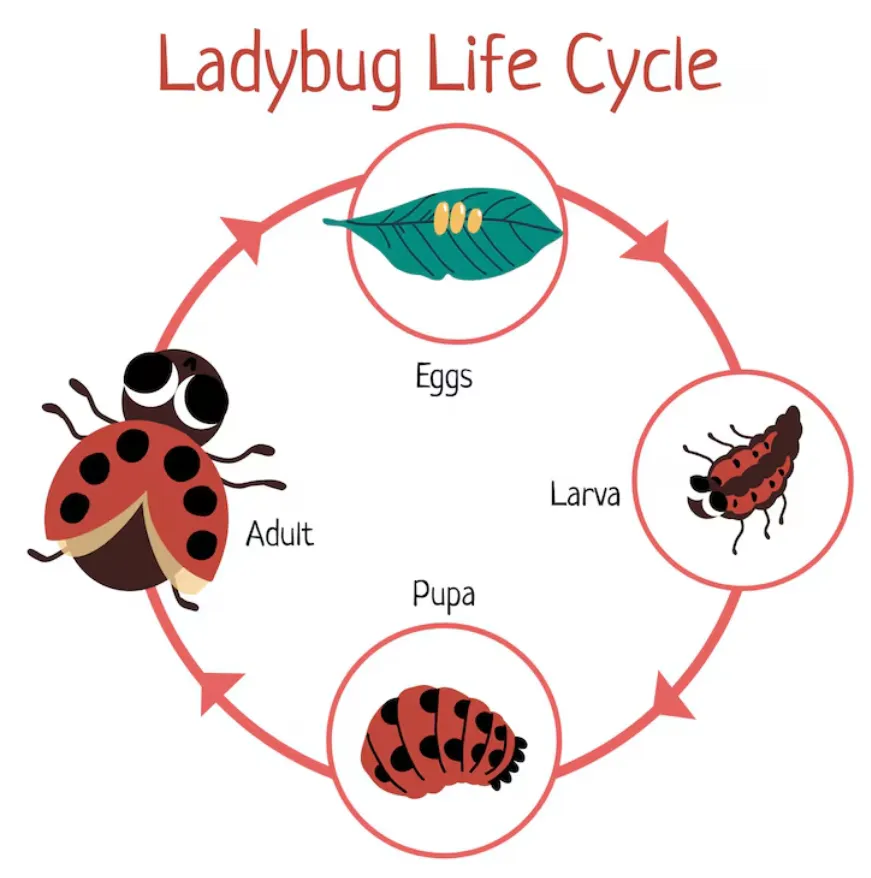
A ladybird passes through complete metamorphosis, which means its body changes through four main stages: egg, larva, pupa, and adult. The young larva looks very different from the adult beetle. It is often dark, active, and alligator-like, while the adult is usually round, smooth, and colorful. This transformation helps ladybirds survive in different ways at different life stages.
Quick Answers: Most Common Questions
Q: What are the four stages in the life cycle of a ladybird?
A: The four stages are egg, larva, pupa, and adult. This is called complete metamorphosis.
Q: How long does the life cycle of a ladybird take?
A: It depends on species, food, and temperature. In many common ladybird beetles, the egg-to-adult process may take several weeks. The larval stage alone can last around 20 to 30 days, and the pupal stage may last 3 to 12 days.
Q: Why are ladybirds important for gardens?
A: Ladybirds are natural pest controllers. Their adults and larvae eat many plant-damaging insects, especially aphids, helping plants grow with less need for chemical insecticides.
Important Things That You Need To Know
When people search for ladybird, they may not always mean the insect. This is why understanding search intent is important for an SEO article about the life cycle of a ladybird. The main topic here is the biological life cycle of the ladybird beetle, but some related search terms have different meanings.
For example, ladybird deed and what is a ladybird deed refer to an estate planning term, not an insect. A Lady Bird deed is commonly described as an enhanced life estate deed that allows a property owner to retain control during life while naming the person who will receive the property upon the owner’s death. This term is legal in nature and is completely separate from Coccinellidae biology.
Another search term, Ladybird Browser, refers to an independent web browser project. Its official site describes it as a new browser engine built from scratch, with an alpha release target for Linux and macOS in 2026.
Searches like ladybird lake, ladybird taco, ladybird atlanta, and similar phrases are also location-, brand-, food-, or local-business-related searches. Lady Bird Lake, for example, is a known lake area in Austin, Texas.
So, in this article, the focus remains on the living insect: the ladybird beetle. These LSI keywords are naturally included to help search engines understand the different meanings of the word ‘ladybird‘ without confusing the reader.
Quick Life Cycle Table
| Life Stage | What Happens | Key Feature | Survival Purpose |
| Egg | Female ladybird lays small yellow or orange eggs near prey colonies. | Eggs are often clustered on leaves or stems. | Young larvae hatch close to food. |
| Larva | Larvae crawl actively and eat pests such as aphids and mites. | They look dark, long, and alligator-like. | This is the main feeding and growth stage. |
| Pupa | The larva attaches to a surface and changes inside its outer body. | The pupa stays mostly still. | The insect transforms into an adult beetle. |
| Adult | The adult emerges, feeds, mates, lays eggs, and may overwinter. | Adults are usually round, domed, and brightly colored. | Adults reproduce and spread to new food areas. |
The History of Their Scientific Naming
The scientific family name of ladybirds is Coccinellidae. This name was introduced by Pierre André Latreille in 1807. The word comes from New Latin coccinella, related to coccinus, meaning ‘scarlet’. This naming is linked to the bright red or scarlet color seen in many familiar ladybird species.
• Coccinellidae is the family name.
• Coleoptera is the beetle order.
• Ladybird beetle is the preferred common name among many entomologists.
• Ladybug is common in North America.
• Ladybird is common in the United Kingdom and some other regions.
The word ladybird has a cultural history, too. In medieval England, these beetles were associated with Our Lady, meaning the Virgin Mary. Farmers saw them as helpful insects because they reduced crop pests. In the United States, the name ladybug became widely used, although scientists prefer lady beetle or ladybird beetle because the insect is a beetle, not a true bug.
This naming history shows how science, color, farming, and culture all shaped the identity of this tiny insect.
Their Evolution And Their Origin
The origin of ladybird beetles dates back to evolutionary history. Ladybirds belong to the beetle order Coleoptera, one of the most diverse insect groups on Earth. Their family, Coccinellidae, includes thousands of described species found worldwide in many habitats. BugGuide notes around 6000 species worldwide, with hundreds found in North America alone.
Scientists study ladybird evolution through body structure, genetics, fossil evidence, and relationships with prey. Fossil records for ladybirds are not as rich as for some other insects because their small bodies do not preserve easily. However, research on fossil ladybirds indicates that the oldest known representatives are from the Eocene, while molecular studies suggest the group may have earlier roots in the Cretaceous.
Their evolution is closely linked with their role as predators. Many ladybirds developed strong hunting abilities, bright warning colors, and chemical defenses. Their red, orange, yellow, and black patterns warn predators that they may taste bad or be toxic. Some ladybirds also use a defense called reflex bleeding, where bitter fluid comes from their leg joints when they are disturbed.
Over time, ladybirds adapted to different food sources. Many became predators of aphids, scale insects, mites, and whiteflies, while some species evolved plant-feeding habits. This flexibility helped them spread across farms, forests, gardens, grasslands, and wetlands.
Their origin story is not just about one insect becoming colorful. It is about millions of years of adaptation, survival, competition for food, defense, and ecological balance.
Their main food and its collection process
The main food of many ladybirds is soft, slow-moving plant pests. The most common prey are aphids, but many species also feed on spider mites, scale insects, whiteflies, small caterpillars, leaf beetle larvae, insect eggs, and other tiny insects. Adults may also feed on nectar, pollen, and honeydew, especially when prey is limited.
Ladybirds collect food by searching plant surfaces carefully. Adults can fly from plant to plant to find prey colonies. Larvae cannot fly, but they crawl quickly across leaves and stems. This is why female ladybirds often lay eggs close to aphid colonies. When larvae hatch, food is already nearby.
• Finding prey: Adult ladybirds use sight, smell, and plant signals to locate pest-rich areas.
• Egg placement: Females lay eggs near aphids or other prey so larvae can feed soon after hatching.
• Larval hunting: Larvae move actively across leaves, often checking the underside where aphids hide.
• Adult feeding: Adults bite and chew prey using beetle mouthparts.
• Backup food: When aphids are scarce, some ladybirds use pollen, nectar, mites, thrips, or insect eggs as extra food.
Food availability directly affects reproduction. Ladybirds need enough prey to build energy for mating and egg production. Cornell notes that lady beetles are especially valuable because some species can survive on other prey when aphids are low.
This food collection process makes the ladybird a natural garden helper. Instead of damaging plants, it often protects them from pest pressure.
Their life cycle and ability to survive in nature
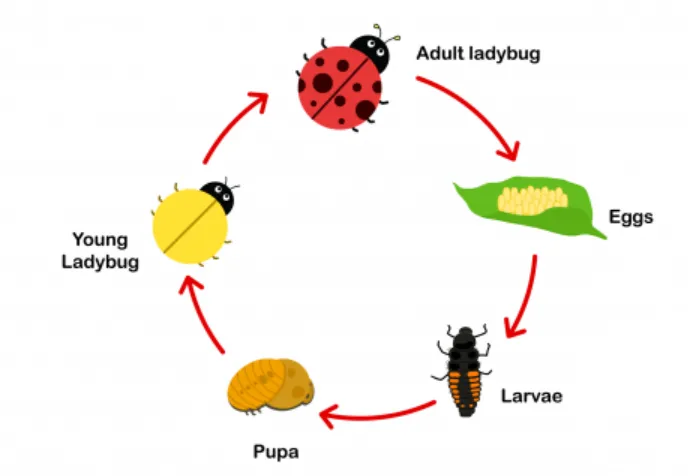
Egg Stage
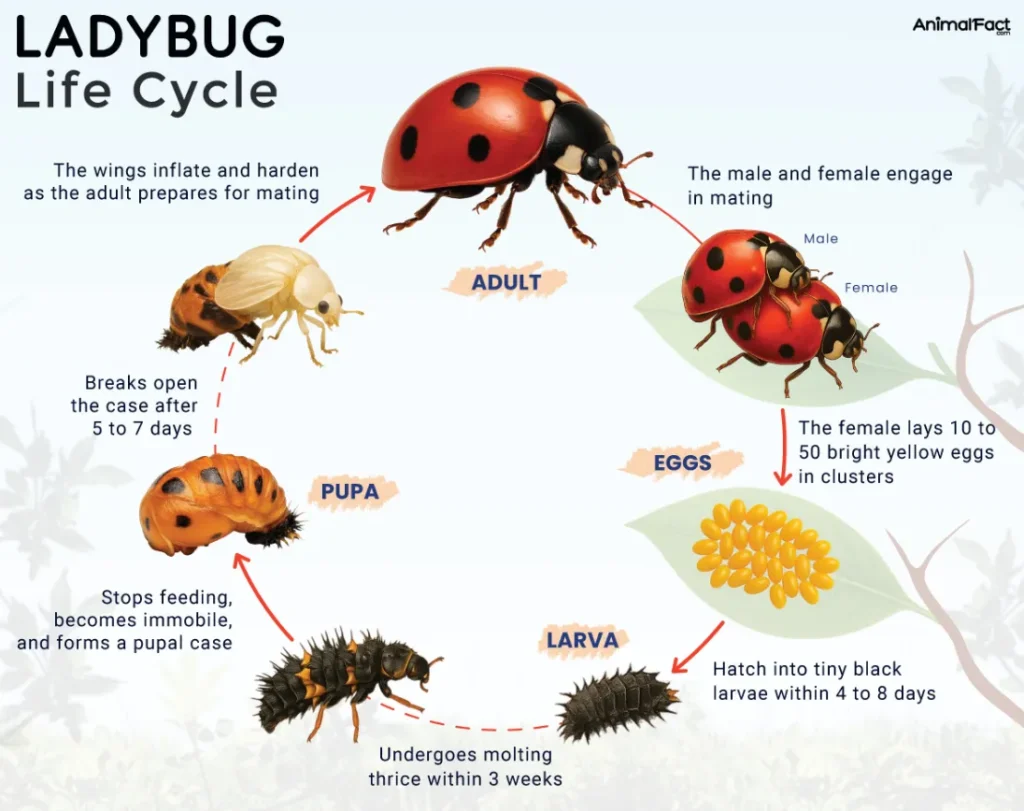
The egg stage begins when a female ladybird lays eggs on leaves or stems. Eggs are often laid in clusters, usually near pest insects. This gives the young larvae a better chance of survival. University of Maryland Extension describes ladybird eggs as tiny, bright yellow-orange, spindle-shaped, and often laid upright in clusters of 5 to 30.
Larva Stage
The larva stage is the most active feeding stage. Ladybird larvae look very different from adult ladybirds. They are often dark, narrow, and alligator-like, with visible legs and markings. They crawl quickly and hunt pests. Cornell notes that larvae usually pass through four larval instars, growing over about 20 to 30 days, depending on species and food.
Pupa Stage
After enough feeding and growth, the larva attaches itself to a leaf, stem, or another surface and becomes a pupa. During this stage, the insect undergoes internal changes. It may look inactive on the outside, but inside, the body is reorganizing into an adult beetle. The pupal stage may last 3 to 12 days, depending on species and temperature.
Adult Stage
The adult ladybird emerges with a softer body at first. Later, its outer covering hardens. Adults feed, mate, lay eggs, and search for new prey colonies. Many ladybirds survive winter as adults in protected places such as leaf litter, bark, rocks, hedgerows, and sometimes buildings.
Their ability to fly, hide, defend themselves, and use different foods helps them survive changing natural conditions.
Their Reproductive Process and raising their children
The reproductive process of ladybirds begins when adults become active during warm seasons. In temperate areas, many ladybirds become more active in spring after overwintering. They feed first, build energy, then mate and lay eggs. Cornell reports that female lady beetles may lay 20 to more than 1,000 eggs over a one- to three-month period, often starting in spring or early summer.
Ladybirds do not raise their children in the way birds or mammals do. They do not feed the larvae directly or guard them for long. Instead, their parenting strategy is smart placement.
• Choosing the right plant: Females search for plants where aphids or other prey are already present.
• Laying eggs in clusters: Eggs are placed close together, often on leaves or stems.
• Providing food access: The mother gives larvae a strong start by laying eggs near prey.
• Reducing early starvation: Larvae hatch near food, so they can begin hunting quickly.
• Producing many eggs: High egg numbers increase the chance that some offspring survive.
Once larvae hatch, they live independently. They must find food, avoid predators, grow through several molts, and eventually pupate. Some larvae may even exhibit cannibalistic behavior when food is scarce, a harsh but natural survival response.
The success of reproduction depends strongly on prey density, temperature, habitat quality, and pesticide exposure. A garden rich in pests, flowers, shelter, and safe leaves gives ladybirds a better chance to complete their life cycle.
The importance of them in this Ecosystem
Natural Pest Control
Ladybirds are among the most recognized beneficial insects because many species naturally reduce pest populations. Both adults and larvae eat aphids and other small pests that damage crops and garden plants. This reduces the need for repeated chemical control and supports healthier plant growth.
Support for Gardens and Farms
Vegetable crops, legumes, strawberries, grain crops, tree crops, and many garden plants can benefit from ladybirds when aphids are present. Cornell states that any crop attacked by aphids may benefit from lady beetles.
Balance in Food Webs
Ladybirds are predators, but they are also prey for birds, spiders, wasps, and other animals. Their presence supports a larger food web. They help keep pest numbers from rising too quickly, while also feeding other species in the Ecosystem.
Reduced Chemical Pressure
When ladybirds are protected, gardeners can depend more on biological balance and less on broad-spectrum insecticides. Broad-spectrum insecticides can harm both pests and beneficial insects. Keeping ladybirds alive helps create a more stable garden system.
Biological Control Value
Lady beetles have a long history in biological control. One famous example involved the vedalia beetle, a ladybird species used against cottony cushion scale in California citrus during the late 1800s. This became one of the classic examples of successful biological control.
In simple words, ladybirds are small insects with large ecological value. They help plants, farmers, gardeners, and natural systems stay healthier.
What to do to protect them in nature and save the system for the future
Protecting ladybirds means protecting the natural pest control system around us. A garden without beneficial insects becomes more dependent on chemicals and more vulnerable to pest outbreaks. The best approach is to create a habitat where ladybirds can feed, reproduce, hide, and overwinter safely.
• Avoid broad insecticides: These chemicals can kill ladybird larvae and adults along with pests.
• Grow flowering plants: Flowers provide nectar and pollen when prey is limited. Good choices include dill, fennel, cosmos, marigold, sunflower, yarrow, and native flowering plants.
• Keep some natural shelter: Leaf litter, bark, hedges, shrubs, and grass edges give adults safe places to hide and overwinter.
• Do not remove all aphids immediately: A small aphid population can attract and feed ladybirds.
• Protect larvae: Ladybird larvae may look strange or scary, but they are helpful pest hunters. Do not mistake them for pests.
• Use water carefully: A shallow water source can help beneficial insects, but avoid deep containers that trap them.
• Build plant diversity: Mixed gardens support more prey, pollen, shelter, and stable insect life.
• Avoid unnecessary ladybird releases: Purchased ladybirds may fly away if the garden lacks food and shelter. Attracting local beneficial insects is often more sustainable. University of Georgia Extension recommends attracting and retaining predators by providing flowers, water, and varied plant structures.
Saving ladybirds is not only about one insect. It is about protecting a living system where plants, predators, prey, soil, and climate work together.
Frequently Asked Questions FAQs
Q: What is the life cycle of a ladybird?
A: The life cycle of a ladybird has four stages: egg, larva, pupa, and adult. This full transformation is called complete metamorphosis.
Q: How long do ladybirds live?
A: Adult ladybirds may live for a few months to over a year, depending on species, climate, food, and winter survival conditions.
Q: What do ladybird larvae eat?
A: Ladybird larvae mainly eat aphids, but they may also eat mites, scale insects, insect eggs, whiteflies, thrips, and small caterpillars.
Q: Are ladybirds good for gardens?
A: Yes. Most ladybirds are good for gardens because they eat plant pests. However, a few species, such as the Mexican bean beetle and squash beetle, can feed on plants.
Q: Where do ladybirds lay eggs?
A: Female ladybirds usually lay eggs on leaves or stems near aphid colonies or other prey. This helps the larvae find food quickly after hatching.
Q: Why do ladybirds have bright colors?
A: Bright colors can warn predators that ladybirds may taste bad or contain defensive chemicals. This warning color system helps many species survive.
Q: Do ladybirds bite humans?
A: Ladybirds are not dangerous to humans. Some may pinch lightly if handled, but they are mainly interested in small insect prey, not people.
Q: What is a ladybird beetle?
A: A ladybird beetle is a small beetle from the family Coccinellidae. It is commonly called a ladybug in North America and a ladybird in the United Kingdom.
Conclusion
The life cycle of the ladybird shows how a tiny insect can play a powerful role in nature. From a small yellow egg to a hungry larva, then a quiet pupa, and finally a bright adult beetle, every stage has a purpose. Ladybirds survive by choosing smart egg-laying sites, hunting soft-bodied pests, using warning colors, hiding during winter, and adapting to changing food sources.
Their value goes far beyond their pretty spotted wings. Ladybird beetles help control aphids, protect crops, support gardens, and reduce the need for harsh chemical insecticides. They are part of a balanced ecosystem in which natural predators help keep plant pests in check.
To protect them, we need safer gardens, more flowers, fewer broad-spectrum insecticides, and more respect for beneficial insects. When ladybirds thrive, plants, soil, farmers, gardeners, and the future Ecosystem all benefit.
Also Read: life cycle of frog





Leave a Reply