
The life cycle of an apple is a fascinating natural process that transforms a tiny seed into a fruit-bearing tree capable of producing delicious apples for decades. Understanding this cycle not only helps gardeners and farmers improve yield but also gives insight into plant biology and ecosystem balance.
Apples (scientifically known as Malus domestica) go through several distinct stages—seed germination, growth, flowering, pollination, fruit development, and finally, seed dispersal. Each stage plays a crucial role in ensuring the survival and reproduction of the apple tree.
This life cycle can take several years to mature fully, but once established, apple trees can produce fruit annually for up to 50 years or more. Climate, soil, and care significantly influence how efficiently this cycle progresses.
🔎 Quick Answers (Most Common Questions)
1. How long does the life cycle of an apple take?
Typically, 4–8 years for a tree to start producing fruit, but the full cycle continues yearly afterward.
2. What are the main stages of an apple’s life cycle?
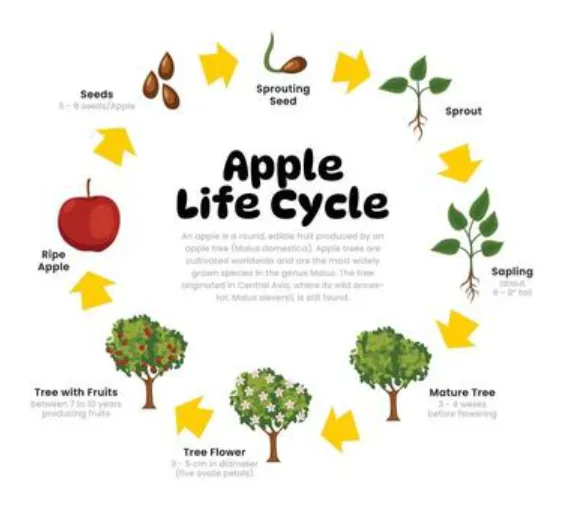
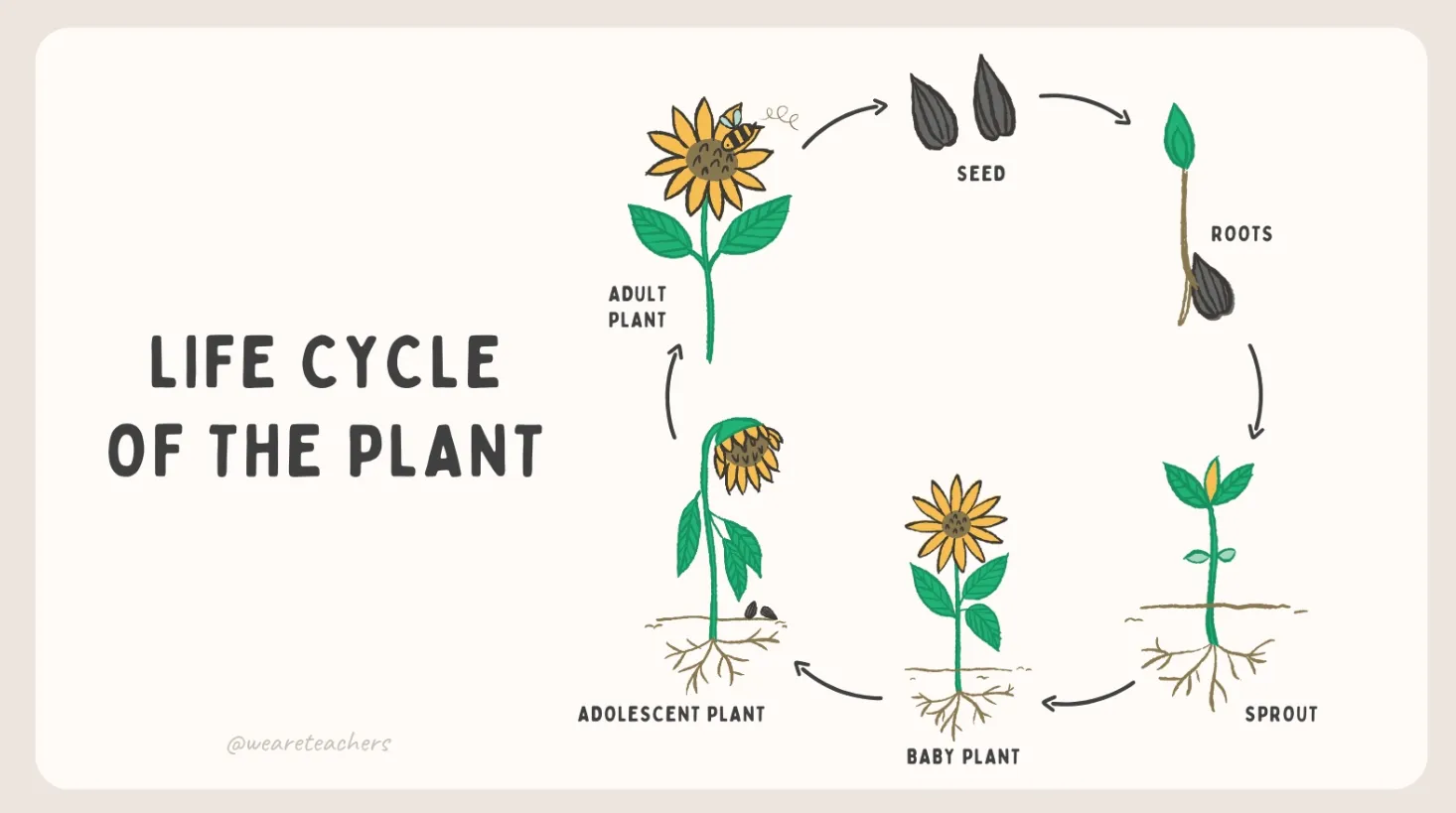
Seed → Germination → Sapling → Mature Tree → Flowering → Pollination → Fruit → Seed Dispersal.
3. Do apple trees need pollination?
Yes, most apple trees require cross-pollination by insects, such as bees, to produce fruit.
Quick Life Cycle Table
| Stage | Description |
| Seed | Apple seeds are formed inside mature fruits |
| Germination | Seeds sprout under favorable conditions |
| Sapling | A young Plant begins growing roots and leaves |
| Mature Tree | Fully grown tree capable of flowering |
| Flowering | Blossoms appear in spring |
| Pollination | Bees transfer pollen between flowers |
| Fruit Development | Fertilized flowers turn into apples |
| Seed Dispersal | Seeds spread to grow new trees |
The History Of Their Scientific Naming
The apple’s scientific classification has evolved over centuries as botanists studied plant taxonomy.
- Apples belong to the genus Malus and species Malus domestica.
- Carl Linnaeus standardized the naming in the 18th century.
- The term “domestica” indicates its cultivated nature.
- Apples are part of the Rosaceae family, which includes roses, pears, and cherries.
- Early botanists grouped apples with wild crabapples because of their similar structures.
- Advances in genetics later confirmed that domesticated apples originated from Malus sieversii.
- Today, scientific naming helps identify over 7,500 apple varieties worldwide.
This classification system ensures clarity across agriculture, research, and global trade, making apples among the most studied fruit crops in the world.
Their Evolution And Their Origin
The apple’s journey began thousands of years ago in the mountainous regions of Central Asia, particularly modern-day Kazakhstan. Wild apple forests still exist there today, showcasing the species’ original genetic diversity.
Early humans discovered these fruits and began cultivating them, eventually selecting sweeter, larger varieties. Through trade routes like the Silk Road, apples spread from Asia to Europe and eventually to North America.
Genetic studies reveal that modern apples are hybrids derived mainly from Malus sieversii, combined with other wild species. This hybridization improved traits such as taste, size, and disease resistance.
During the Roman Empire, apple cultivation became widespread, and grafting techniques were introduced to preserve desirable traits. Later, European settlers brought apples to America, where they became a staple crop.
Today, apples are grown in temperate regions worldwide. Their evolution reflects human influence, natural selection, and agricultural innovation. Modern breeding programs continue to enhance apple varieties for flavor, storage, and climate adaptability.
Their main food and its collection process
Apple trees produce their own food through photosynthesis, making them autotrophic organisms.
🌿 Key Points:
- Apple trees absorb sunlight using chlorophyll in their leaves.
- Carbon dioxide from the air enters through leaf pores (stomata).
- Roots absorb water and minerals from the soil.
- Sunlight converts these into glucose (food) and oxygen.
- The produced energy supports growth, flowering, and fruiting.
- Sugars are transported to fruits, making apples sweet.
- Nutrients are stored in roots during winter dormancy.
🍏 Collection Process:
- Fruits develop after pollination and fertilization.
- Apples are harvested when fully ripe.
- Farmers assess color, size, and firmness before picking.
- Harvesting is usually done manually to prevent damage.
- Apples are stored in controlled environments to extend shelf life.
This natural food production process ensures the apple tree sustains itself and produces nutritious fruit for humans and wildlife.
Their life cycle and ability to survive in nature
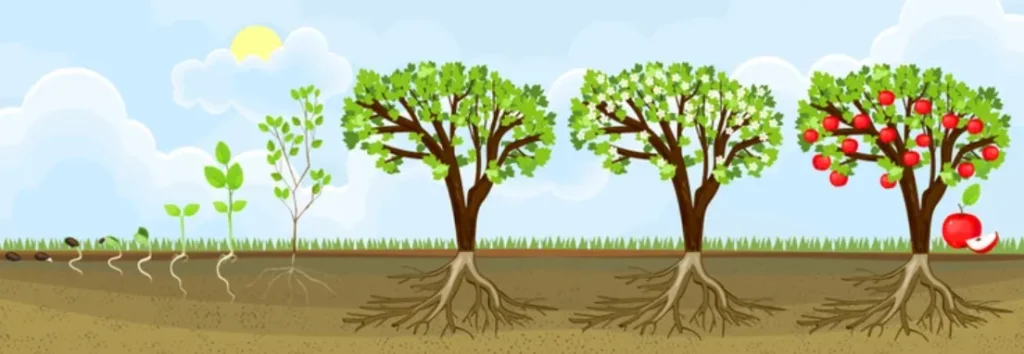
🌱 Seed Stage
The cycle begins when seeds are dispersed from mature apples. These seeds require cold stratification to germinate.
🌿 Germination Stage
Seeds sprout when exposed to moisture, warmth, and oxygen. Roots grow downward, while shoots grow upward.
🌳 Growth Stage
The sapling develops into a young tree. It forms branches, leaves, and a strong root system.
🌸 Flowering Stage
In spring, blossoms appear. These flowers are essential for reproduction.
🐝 Pollination Stage
Bees and insects transfer pollen between flowers, enabling fertilization.
🍎 Fruiting Stage
Fertilized flowers develop into apples containing seeds.
🍂 Dormancy Stage
During winter, the tree enters dormancy to conserve energy.
Apple trees survive through seasonal adaptation, deep root systems, and nutrient storage. Their resilience allows them to thrive in diverse climates.
Their Reproductive Process and raising their children
Apple trees reproduce sexually through flowers and seeds.
🌸 Key Points:
- Flowers contain both male (stamens) and female (pistils) parts.
- Pollination occurs when pollen reaches the stigma.
- Fertilization leads to seed formation inside the fruit.
- Each apple contains multiple seeds capable of growing new trees.
- Cross-pollination increases genetic diversity.
- Animals or humans disperse seeds.
- New trees grow from seeds or through grafting techniques.
🌱 Raising Their “Children”:
- Seeds require proper soil and climate conditions.
- Farmers often use grafting to produce higher-quality trees.
- Young plants need sunlight, water, and nutrients.
- Protection from pests ensures healthy growth.
This reproductive strategy ensures the survival of the apple species across generations.
The importance of them in this Ecosystem
🌍 Environmental Role
Apple trees contribute to oxygen production and carbon absorption.
🐝 Pollinator Support
They provide nectar for bees, supporting biodiversity.
🐦 Wildlife Habitat
Birds and animals rely on apple trees for food and shelter.
🌱 Soil Health
Fallen leaves enrich soil nutrients.
🍎 Human Benefits
Apples are a major source of nutrition and economic value.
Apple trees play a vital role in maintaining ecological balance and supporting multiple life forms.
Important Things That You Need To Know
Understanding the life cycle of an apple becomes easier when you explore related concepts like apple tree growth stages, apple seed germination process, apple fruit development, and apple tree pollination cycle.
The apple tree growth stages begin with seed germination and progress through sapling, maturity, and fruit production. Each stage requires specific environmental conditions to succeed.
The apple seed germination process is unique because seeds need a cold period before sprouting. This ensures they grow in the right season.
The apple tree pollination cycle is critical, as most apple trees cannot self-pollinate. Bees play a key role in transferring pollen, making them essential for fruit production.
The apple fruit development stage transforms fertilized flowers into juicy apples. Nutrients from the tree are directed into the fruit, enhancing flavor and size.
By understanding these interconnected processes, you gain a deeper appreciation of how apple trees grow, reproduce, and sustain ecosystems.
What to do to protect them in nature and save the system for the future
- 🌱 Plant more apple trees in suitable climates
- 🐝 Protect pollinators like bees by avoiding pesticides
- 💧 Ensure proper irrigation and water conservation
- 🌍 Promote organic farming practices
- 🌿 Maintain soil health using natural fertilizers
- 🚫 Reduce chemical usage in agriculture
- 🌳 Prevent deforestation and habitat destruction
- 📚 Educate communities about sustainable farming
- ♻️ Encourage eco-friendly storage and packaging
- 🛡️ Protect trees from pests and diseases naturally
These actions help preserve apple trees and ensure long-term ecological balance.
Frequently Asked Questions (FAQs)
1. What is the life cycle of an apple?
It includes seed, germination, growth, flowering, pollination, fruiting, and seed dispersal.
2. How long do apple trees live?
They can live up to 50–100 years depending on care and environment.
3. Why is pollination important for apples?
It allows fertilization, leading to fruit production.
4. Can apple trees grow from seeds?
Yes, but they may not produce fruit identical to the parent tree’s.
5. What season do apple trees bloom?
They typically bloom in spring.
6. How do apples develop?
From fertilized flowers after pollination.
7. What animals help disperse apple seeds?
Birds, mammals, and humans.
8. What affects apple tree growth?
Climate, soil quality, water, and sunlight.
Conclusion
The life cycle of an apple is a remarkable example of nature’s precision and resilience. From a tiny seed to a fruit-bearing tree, each stage is interconnected and essential for survival. This cycle not only ensures the continuation of apple trees but also supports ecosystems, wildlife, and human life.
Understanding this process helps farmers improve productivity, gardeners nurture healthier trees, and individuals appreciate the natural world more deeply. With proper care, apple trees can thrive for decades, providing nourishment and environmental benefits.
Protecting apple trees and their habitats is crucial for future generations. By promoting sustainable practices and preserving biodiversity, we can ensure this incredible life cycle continues to flourish worldwide.
Also Read About: life cycle of a bed bug





Leave a Reply